Insight
The Access-Driven Enterprise: How Health Systems Are Defining, Enabling, and Advancing Access Strategy
This Article Covers
- What Is an Access-Driven Enterprise?
- Why Access Has Become a Strategic Priority
- How Health Systems Are Investing in Access
- Why Health Systems Still Struggle To Deliver Seamless Access
- The Biggest Barriers to Transformation
- How Tegria Helps Drive Access Initiatives
- How AI Is Reshaping Access Strategy
- Closing the Access Execution Gap
- Explore Tegria's Solutions
- Access + Experience
Access Has Entered a New Strategic Era
Patient access transformation has reached an inflection point. Health systems are redefining access beyond appointment scheduling to encompass the entire patient journey, from digital front doors and self-scheduling to care navigation and seamless transitions across settings.
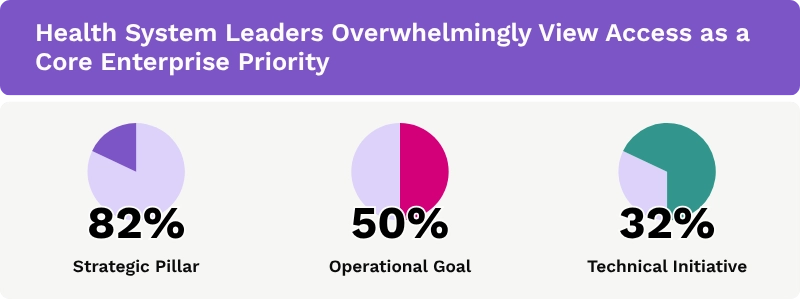
Organizations are investing heavily in virtual care, centralized scheduling, AI-powered communications, and digital navigation tools. Yet many still struggle with appointment availability, fragmented digital experiences, workforce shortages, and technology integration challenges. New research from Tegria and The Health Management Academy reveals that, while 82% of health systems now position access as a strategic pillar, major execution gaps continue to stall transformation efforts.
The systems that succeed in the next phase of healthcare transformation will treat access not as an operational outcome, but as a core enterprise capability that connects access strategy to finance, digital innovation, and patient experience.
Key Findings
- 82% position access as a strategic pillar
- 62% cite appointment availability as the greatest execution gap
- 54% cite workforce shortages as the top barrier to success
- 61% are investing in AI-powered patient communications
Dive Deeper Into the Research
What Is an Access-Driven Enterprise?
Healthcare access is no longer viewed as a narrow operational function centered on scheduling and call centers. Health systems are increasingly reframing access strategy as a multidimensional enterprise strategy that influences growth, financial performance, patient experience, digital transformation, and operational sustainability.
This shift reflects mounting pressure across the healthcare landscape. Consumer expectations for convenience continue to rise. Workforce shortages are straining capacity across clinical settings. Financial pressures are forcing organizations to prioritize investments with measurable returns. At the same time, digital transformation initiatives have accelerated dramatically, creating both new opportunities and new operational complexity.
The Access-Driven Enterprise research, developed by Tegria and The Health Management Academy (THMA), examines how leading health systems are navigating this transformation. Based on survey data and executive interviews with senior healthcare leaders—including COOs, CIOs, CMIOs, strategy executives, and CFOs—the research reveals a healthcare industry in transition.
The findings point to a central paradox: Health systems have elevated access to a strategic priority and are investing aggressively in digital capabilities, but most continue to struggle translating ambition into operational execution.
This execution gap is rapidly becoming one of healthcare’s defining operational and strategic challenges.
Why Access Has Become a Strategic Priority
Access now sits alongside growth, quality, and finance as a core enterprise concern. This elevation reflects a broader understanding of what access means in today’s healthcare environment.
Organizations increasingly define access as:
- Digital front door experience
- Omnichannel patient engagement
- Care navigation
- Scheduling optimization
- Capacity management
- Seamless care transitions
- Workforce enablement
- Operational coordination
Executive oversight has also intensified. Some 93% of organizations review access strategy at least quarterly, underscoring the degree to which access has become embedded in boardroom and C-suite discussions.
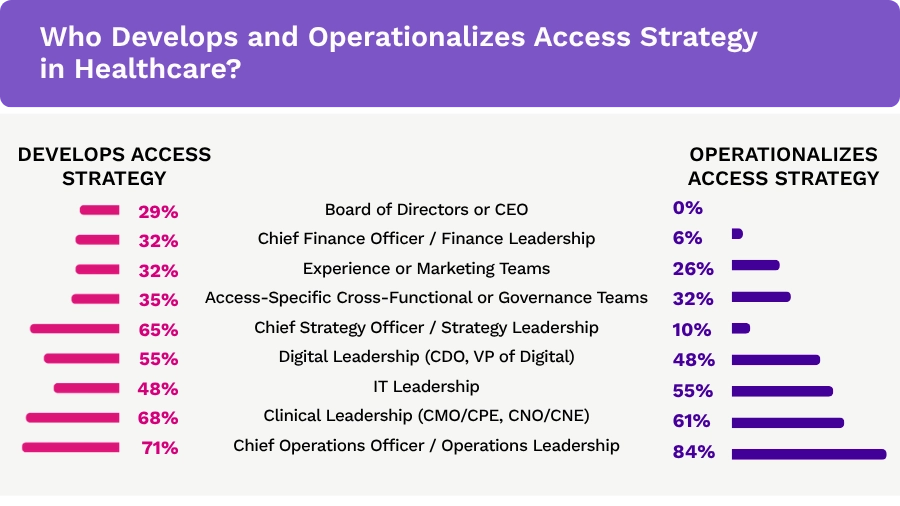
Yet despite this strategic elevation, governance inconsistencies remain widespread. Many organizations still lack a shared enterprise-wide definition of access, creating fragmented ownership across operational, clinical, digital, and IT teams. This governance challenge helps explain why many organizations continue to struggle operationally despite strong executive alignment around access priorities.
Without a shared, enterprise-wide definition of access and disciplined governance around it, systems struggle to execute consistently, coordinate stakeholders, and deliver on growth, revenue, and experience goals.
How Health Systems Are Investing in Access
As access becomes increasingly strategic, organizations are directing substantial investments toward digital infrastructure, virtual care, scheduling modernization, and AI-enabled engagement tools.
The strongest investment activity is occurring in technologies that improve convenience, coordination, and operational efficiency:
- 81% are investing in telehealth and virtual care platforms
- 77% in centralized scheduling systems
- 65% in digital navigation tools
- 61% in AI-powered patient communications
- 58% in self-service portals
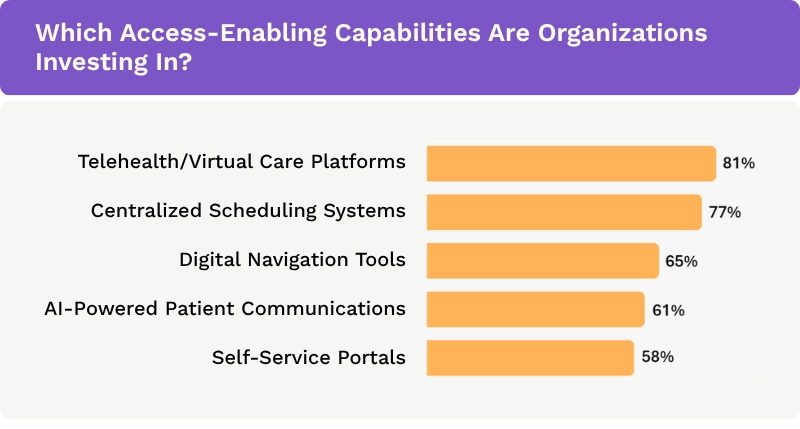
These investments reflect a broader recalibration of healthcare access strategy. Rather than focusing solely on expansion, many organizations are now prioritizing optimization to improve how existing systems, workflows, and technologies operate together across the enterprise.
The research also shows that organizations are increasingly favoring integrated enterprise platforms over fragmented point solutions. Some 78% of leaders agree that access strategy depends on a single enterprise platform, while 65% report vendor consolidation has improved integration.
At the same time, financial realities continue to shape investment decisions. CFOs interviewed for the research emphasized that organizations must prioritize initiatives with clear operational and financial returns.
With limited capital at our fingertips ... our focus is going to be more on what is that direct throughline to ROI.
CHIEF FINANCIAL OFFICERWestern U.S. Integrated Delivery Network
This ROI pressure is influencing how organizations approach emerging technologies such as AI, predictive analytics, and automation. Systems with stronger financial positions can pursue longer-term digital transformation initiatives, while others remain focused on near-term operational improvements and billable service optimization.
Benchmark Your Access Strategy Against Your Peers
Why Health Systems Still Struggle To Deliver Seamless Access
Despite strategic alignment and significant investment, most organizations continue to face major operational execution gaps.
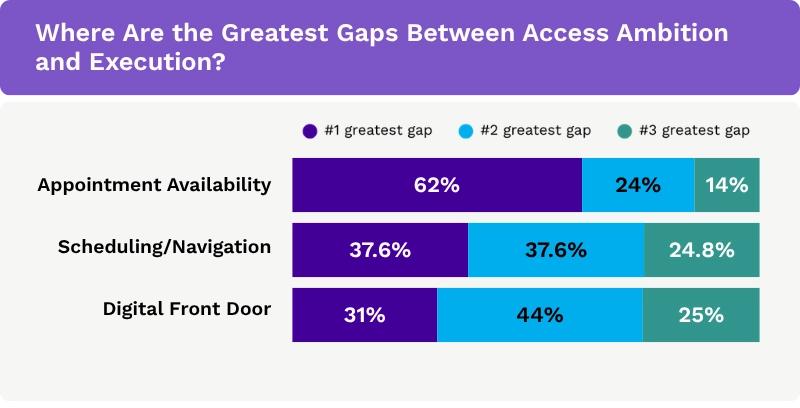
The most significant challenge remains appointment availability and wait times. Some 62% of respondents identified this as the greatest gap between access ambitions and current execution.
This gap reflects a persistent imbalance between patient demand and provider capacity—a challenge exacerbated by workforce shortages, operational fragmentation, and growing consumer expectations.
Digital experience gaps also remain widespread:
- 38% report weaknesses in scheduling and navigation
- 31% cite digital front door experience as a major gap
- 31% identify cross-functional coordination challenges
The findings suggest that many organizations have successfully invested in digital tools but have not yet achieved the seamless, integrated experience patients increasingly expect.
The report captures this tension directly:
“While organizations have invested heavily in their digital ecosystems, few have yet realized the seamless, omnichannel experience patients expect.”
This is the core execution paradox shaping the next phase of healthcare access transformation.
Strategic elevation and investment alone are not enough. Sustainable transformation requires organizations to operationalize access consistently across departments, workflows, technologies, and care settings.
The research also highlights growing coordination challenges across leadership teams. Responsibility for access often spans operations, IT, digital, strategy, and clinical leadership, creating blurred accountability and slower decision-making.
As organizations continue expanding virtual care, hybrid delivery models, and AI-enabled workflows, the need for enterprise-level governance and operational alignment will only intensify.
The Biggest Barriers to Transformation
While execution gaps remain significant, health systems also face mounting operational and market pressures that complicate transformation efforts.
The research identified three dominant internal barriers:
- Workforce shortages (54%)
- Financial constraints (43%)
- Technology integration challenges (36%)
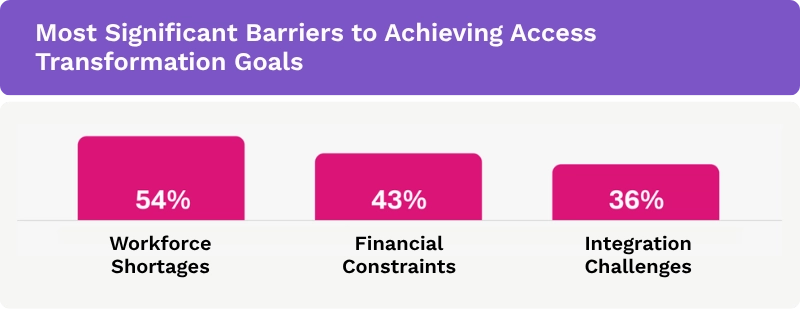
Among these, workforce shortages emerged as the defining challenge across the healthcare landscape. Executives consistently described provider supply constraints as a long-term structural issue limiting organizational capacity and slowing access improvement initiatives.
Our biggest gap is do we have enough [providers], which I think everybody is struggling with ... and so we're looking at things like how do we increase the capacity of our own infrastructure ... is there a different model?
CHIEF FINANCIAL OFFICEREastern U.S. Integrated Delivery Network
These internal barriers are compounded by powerful external forces:
- 82% report workforce supply struggles as the most significant external barrier
- 71% note payer reimbursement shifts
- 50% identify consumer pressure for convenience and outcomes
Together, these dynamics are forcing organizations to balance financial discipline, digital modernization, workforce sustainability, and patient experience simultaneously.
The findings suggest that access transformation is no longer simply a technology initiative. It has become a broader enterprise resilience challenge requiring stronger governance, tighter operational coordination, and measurable ROI alignment across the organization.
How Tegria Helps Drive Access Initiatives
Health systems seeking to close the access execution gap often need more than technology investments alone. Sustainable transformation requires operational alignment, governance, workflow optimization, digital integration, and measurable execution support across the enterprise.
Tegria partners with healthcare organizations to help operationalize access transformation strategies that improve patient experience, strengthen workforce efficiency, and support long-term organizational performance.
Tegria's Access Transformation Capabilities
- Enterprise access strategy — Align governance and operations
- Digital front door optimization — Improve omnichannel experiences
- Centralized scheduling — Streamline patient access workflows
- Capacity management — Optimize provider utilization
- Care navigation design — Improve patient journey coordination
- AI-enabled patient communications — Modernize engagement workflows
- Access analytics and reporting — Improve operational visibility
- Epic access optimization — Enhance scheduling and workflows
- Workforce optimization — Support staffing efficiency initiatives
- Contact center modernization — Improve access responsiveness
- Operational workflow redesign — Reduce friction across teams
- Technology integration strategy — Connect fragmented platforms
How AI Is Reshaping Access Strategy
AI and automation are rapidly becoming defining forces in the next phase of healthcare access transformation. While health systems have spent the past several years building foundational digital infrastructure—deploying virtual care platforms, centralized scheduling systems, patient portals, and digital navigation tools—the industry is now entering a new operational phase focused on optimization, orchestration, and intelligent automation.
The Access-Driven Enterprise research suggests that healthcare organizations increasingly view AI not as a standalone innovation initiative, but as an operational enabler capable of helping systems address some of their most pressing access challenges: staffing shortages, scheduling inefficiencies, fragmented patient communication, administrative burden, and limited capacity visibility.
This shift is occurring at a critical moment for healthcare leaders. Workforce shortages continue to constrain capacity across the care continuum. Financial pressures are forcing organizations to prioritize investments with measurable operational returns. At the same time, patient expectations for convenience, speed, and digital engagement continue to rise.
Rather than viewing access transformation solely through the lens of physical expansion or staffing growth, health systems are increasingly exploring how automation, predictive analytics, and AI-enabled workflows can help maximize existing operational capacity while improving patient experience.
The research reflects this growing momentum:
- 61% of organizations are investing in AI-powered patient communications
- 55% are investing in predictive analytics
- 48% are investing in workforce management systems
- 42% are investing in contact center modernization
These investments indicate that organizations are moving beyond basic digital access capabilities and beginning to focus more directly on intelligent orchestration across the patient journey.
Importantly, the findings also suggest that most organizations are approaching AI adoption pragmatically rather than experimentally. Health systems are not seeking wholesale replacement of existing systems or workflows. Instead, they are embedding AI capabilities within their current enterprise infrastructure to enhance efficiency, coordination, and decision-making.
I'm seeing AI as an ability to be a veneer on top rather than tearing up the sidewalk and laying new concrete.
CHIEF FINANCIAL OFFICERMidwestern U.S. Academic Medical Center
This operational mindset helps explain why embedded AI capabilities within enterprise systems are gaining traction. Organizations increasingly favor AI tools that:
- Improve scheduling efficiency
- Reduce administrative burden
- Support patient communication
- Surface operational insights
- Optimize workforce utilization
- Enhance navigation and coordination
- Improve capacity forecasting
- Enable faster decision-making
The goal is not simply automation for automation’s sake. The larger objective is creating more connected, responsive, and scalable access operations.
The research also highlights how AI is reshaping organizational leadership dynamics. Historically, access strategy often sat primarily within operational or patient access functions. But as AI capabilities become increasingly integrated into enterprise workflows, digital and IT leaders are playing a much more central strategic role.
This evolution reflects the growing interdependence between operational strategy and digital infrastructure. AI implementation now touches virtually every component of the access ecosystem:
- Scheduling systems
- Contact centers
- Workforce management
- Clinical workflows
- Patient engagement
- Data analytics
- Capacity planning
- Care navigation
As a result, access transformation increasingly requires cross-functional governance models that align operations, digital strategy, IT leadership, finance, and clinical stakeholders.
The report notes that many organizations still struggle with fragmented ownership and governance structures surrounding access initiatives. As AI adoption accelerates, these governance gaps could become even more consequential. Organizations that lack clear accountability, integrated data strategies, and operational alignment may find it difficult to scale AI capabilities effectively across the enterprise.
How Leading Health Systems Are Closing the Access Execution Gap
At the same time, the research suggests that health systems remain relatively early in their AI maturity journey. While interest and investment are widespread, most organizations are still progressing through foundational stages of operational AI adoption. The report outlines a clear evolution in how AI capabilities are emerging within healthcare access environments:
- Workflow automation
- Predictive analytics
- Generative AI
- Agentic AI
Today, workflow automation serves as the most common entry point. Organizations are using automation to streamline repetitive administrative processes, improve scheduling coordination, reduce manual work, and support revenue cycle operations.
Predictive analytics represents the next layer of maturity. Health systems are increasingly exploring how forecasting tools can help anticipate patient demand, reduce no-shows, improve staffing allocation, and optimize appointment capacity utilization.
Generative AI initiatives are also beginning to expand across operational and patient-facing functions. Early applications include:
- Patient communication support
- Documentation assistance
- Administrative summarization
- Contact center augmentation
- Digital messaging
- Knowledge support tools
Meanwhile, agentic AI capabilities remain largely exploratory but represent a potentially transformative long-term opportunity. Organizations are beginning to evaluate how intelligent assistants and automated workflow coordination tools could eventually support more autonomous scheduling, navigation, and patient engagement functions.
Despite this momentum, the report maintains a notably grounded tone regarding AI adoption. The findings repeatedly reinforce that technology alone will not solve healthcare access challenges.
The greatest obstacles to transformation remain operational and organizational:
- Workforce shortages
- Financial constraints
- Fragmented governance
- Technology integration complexity
- Capacity limitations
In many ways, AI is best understood as an amplifier rather than a standalone solution. Organizations with strong governance, integrated workflows, interoperable infrastructure, and aligned leadership teams will be better positioned to operationalize AI successfully. Those with fragmented operational structures may struggle to translate AI investment into measurable enterprise improvement.
The report also highlights another important nuance in healthcare AI adoption: Workforce acceptance varies significantly across clinical roles and organizational groups.
Physicians tend to show stronger adoption and exposure across many AI-enabled tools, while nursing leaders demonstrate greater support in areas such as virtual assistants, ambient sensors, and remote monitoring technologies. These differences create important change management considerations for organizations seeking to scale AI capabilities enterprise-wide.
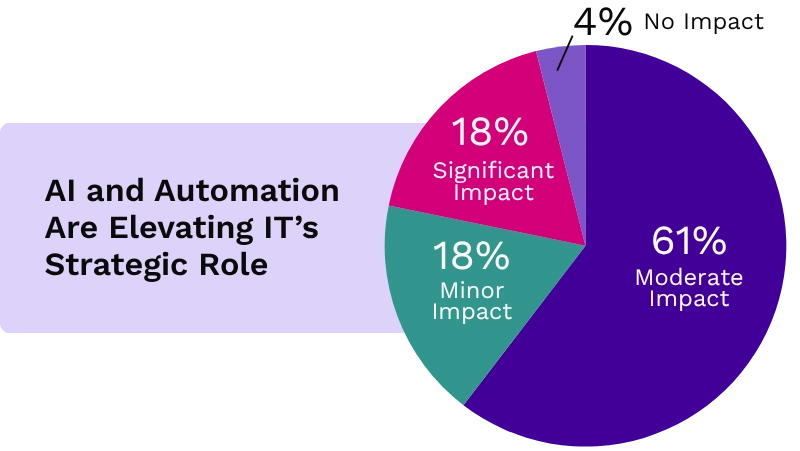
79% of respondents say AI and advanced automation technologies are having at least a moderate impact on the involvement of enterprise IT and digital leadership in access strategy.
As healthcare organizations move into the next phase of access transformation, successful AI strategies will likely depend less on acquiring the newest technology and more on embedding intelligence thoughtfully into operational workflows that already shape patient experience and organizational performance.
The report ultimately frames AI not as a separate innovation category, but as part of a broader enterprise access strategy focused on integration, scalability, and operational resilience. In that sense, AI is becoming more than a technology initiative. It is increasingly functioning as a catalyst for broader organizational transformation, reshaping how health systems coordinate care, manage capacity, engage patients, and operationalize access at scale.
Closing the Access Execution Gap
Healthcare access transformation has entered a new phase.
The research makes clear that health systems have already recognized access as a strategic imperative. Executive sponsorship is strong. Investment activity is accelerating. Digital capabilities continue expanding across the enterprise.
The next challenge is execution.
Organizations must now bridge the widening gap between access strategy and operational reality by aligning governance, workforce strategy, digital infrastructure, financial priorities, and enterprise operations.
Organizations that align governance across disciplines, invest in interoperable infrastructure, and scale AI capabilities within existing platforms to drive both efficiency and experience will be best positioned to close the gap between access ambition and execution.
The health systems that succeed will be those that:
- Treat access as an enterprise capability
- Align cross-functional governance
- Integrate digital and operational workflows
- Operationalize AI strategically
- Focus on scalable, measurable transformation
The future of healthcare access will not be defined solely by technology adoption. It will be defined by how effectively organizations connect access strategy, operations, digital innovation, and patient experience into a cohesive enterprise model.
Download the Access-Driven Enterprise Report
Explore the complete research findings from Tegria and The Health Management Academy, including executive insights, investment trends, operational barriers, AI adoption patterns, and strategic recommendations for advancing healthcare access transformation.
About the research: This report synthesizes findings from a survey of senior health system executives (COOs, CIOs, CMIOs, and strategy leaders) from leading U.S. health systems. To understand the financial backdrop that influences access strategy, survey results were augmented with data from a survey and follow-up conversations with health system finance leaders. CFOs offer a critical lens often missing from access discussions: They control capital allocation, shape ROI discipline, and balance digital investments with budgetary pressures. Their perspective reveals how financial constraint, not just strategic intent, informs access transformation.
For more information about this study, please download the report.