Insight
Access Is the New Enterprise Strategy
82% of health systems call it a strategic pillar. Most still struggle with appointment availability, scheduling, and digital execution.
Access has entered a new strategic era.
What was once treated as an operational function—scheduling appointments, managing referrals, coordinating care—has evolved into a comprehensive enterprise priority that health systems now position alongside growth, quality, and finance.
Yet despite this fundamental shift in how organizations define, govern, and invest in access, critical execution gaps persist. Systems struggle translating strategic intent into operational reality, falling short on key access metrics: appointment availability, scheduling efficiency, and seamless digital experiences.
Tegria and The Health Management Academy partnered to understand this paradox. Our new report, The Access-Driven Enterprise: How Health Systems Are Defining, Enabling, and Advancing Access Strategy, examines how health system executives are navigating this transformation: where they're investing, what barriers they face, and what separates strategic ambition from measurable results.
Making Access an Enterprise-Wide Priority
Access is no longer confined to IT departments or operations teams. Health systems are now viewing access as a comprehensive capability that connects clinical care delivery, digital innovation, and operational strategy, positioning it as foundational to organizational performance rather than a narrow scheduling function.
Researchers interviewed chief financial officers from leading health systems, who emphasized that access has become a unifying strategic focus across health system leadership. "Our priorities 1-2-3 are access, access, and access," said one CFO from a major Midwestern U.S. academic medical center.
Our priorities 1-2-3 are access, access, access.
CFOMidwestern U.S. Academic Medical Center
Another CFO emphasized how access serves as an organizational rallying point: "If access is for everybody, you can connect a lot of dots from a payer mix perspective to a community perspective, to a leakage perspective, to a health plan perspective. It does feel like it's a rallying cry that almost everybody in the organization can see themselves in," explained a CFO from a large Western/Pacific U.S. integrated delivery network.
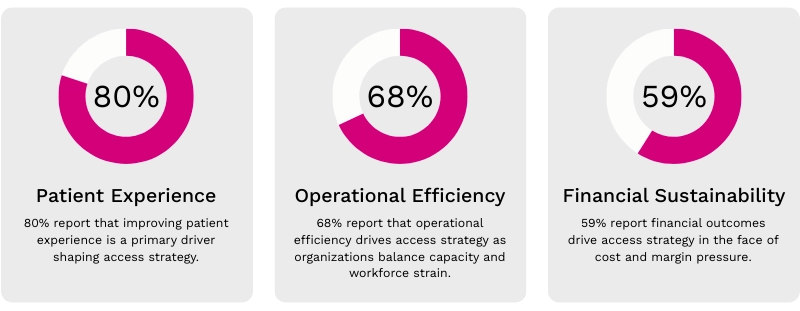
Nearly all respondents identify improving patient experience as the primary driver of their access strategy, underscoring the centrality of patient-centered design. Increasing operational efficiency (68%) and achieving financial sustainability (59%) were also identified as key drivers, as health systems balance capacity, cost, and growth amid workforce and margin pressures. In contrast, fewer leaders cite competitive pressures or health equity concerns as primary drivers—suggesting organizations are prioritizing foundational goals related to experience and operational sustainability.
Access has gained high-level attention, with a broader range of executives now involved in pursuing access strategy. Chief operating officers (32%), clinical leaders (29%), strategy officers (24%), and IT executives play the biggest roles in championing access transformation. In fact, 93% of organizations review their access strategy at least quarterly at the board level, signaling sustained executive commitment.
C-Suite Strategy
93% of health systems review access strategy at least quarterly at the board level.
The Finance Gap
However, a critical gap exists in both strategy development and execution: Only 32% report Finance involvement in strategic development, and just 7% report Finance participation in operationalization. This absence may hinder long-term financial backing and ROI discipline—creating a disconnect between access strategy expectations and the capital allocation decisions that determine what's actually possible.
"The systems that will succeed are those that treat access not as an outcome to achieve, but as a core strategic capability," said Steve Nilson, Principal Program Manager for Access + Experience at Tegria. "But that requires finance, strategy, and operations to be aligned from the beginning, not just at the strategy table, but throughout execution."
Investing in Access Transformation
Health systems are going beyond strategy development to devote significant resources toward enhancing access. Investment priorities remain broad and multifaceted, reflecting increased care demand and pressure to shift to more cost-effective sites of care. Systems are prioritizing digitally enabled care such as telehealth, as well as ambulatory and hospital-based sites. Post-acute settings—long-term care facilities, rehabilitation, and home-based acute care—rank at the bottom of investment priorities, despite creating significant throughput bottlenecks.
Beyond physical infrastructure, systems are investing heavily in patient-facing digital capabilities. Virtual care platforms, centralized scheduling systems, digital navigation tools, self-service portals, and AI-powered patient communication innovations such as chatbots are receiving significant budget allocation.
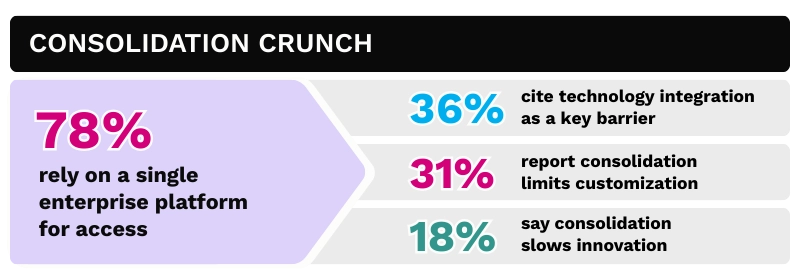
This investment pattern reflects a strategic shift: Systems are focusing on optimization over expansion. With many core digital capabilities implemented during and after COVID-19, the focus has moved from deploying new tools to making existing platforms work better together. In fact, 77% agree that access strategy now depends on a single enterprise platform, with nearly two-thirds reporting that vendor consolidation has improved integration.
Yet this consolidation comes with trade-offs. While it creates stability and interoperability, 31% report it limits customization and 18% say it slows innovation, revealing the tension between standardization and flexibility.
The CFO Dilemma
Interviews with health system CFOs revealed a critical dynamic shaping these investment decisions: The question isn't whether digital innovation matters, but whether it delivers immediate, measurable ROI.
"With the limited capital at our fingertips … our focus is going to be more on what is that direct through line to ROI," explained a CFO from a large Western U.S. integrated delivery network.
With the limited capital at our fingertips … our focus is going to be more on what is that direct through line to ROI.
CFOWestern U.S. Integrated Delivery Network
Another CFO illustrated the trade-off more starkly: "Do I invest $10 million in a telemedicine platform I may make $5 million on, or do I take that $10 million and try to recruit new docs, put physical buildings and people, and build the ambulatory structure[s]?" asked a CFO from a comprehensive Southern U.S. academic medical center.
This calculation determines which digital tools secure funding and which stagnate despite strategic potential. Systems with stronger balance sheets and diversified revenue—such as vertically integrated systems with health plans—can afford longer-term bets on AI and predictive analytics. Systems under acute financial pressure must prioritize billable services and immediate workflow improvements.
The result is a widening gap between risk-accepting and risk-averse organizations. CFOs at financially constrained systems prioritize immediate ROI and maintain strict financial discipline around digital enablement, focusing on billable services with clear revenue connections. Meanwhile, CFOs at stronger-performing systems leverage diversified revenue portfolios, stronger operating margins, and organizational maturity to pursue investments where value may emerge through multiple degrees of separation.
Revealing the Execution Gaps
Systems have embraced access-improvement goals, developed strategies, and made investments. Yet wide gaps persist between their goals and what they have achieved.
"Health systems continue to struggle translating ambition into execution," the report noted. The gaps they've identified point to the greatest opportunities for improvement—the places on which to concentrate and focus.
The widest gap lies in appointment availability and wait times, a persistent frustration for patients. Most respondents cite this as their greatest or second-greatest gap between what they aim to achieve and what they have accomplished, underscoring the persistent disparity between patient demand and providers' ability to meet it.
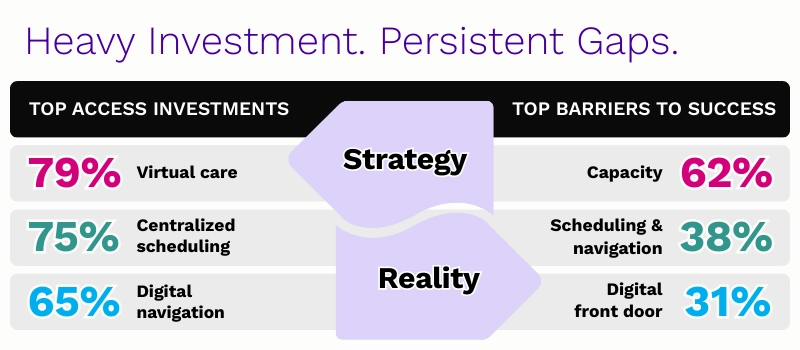
Digital access and navigation capabilities also remain underdeveloped. Some (38%) identify patient scheduling and navigation as a weakness, while 31% cite digital front door experience as a key gap. These challenges suggest that, while organizations have invested heavily in their digital ecosystems, few have yet realized the seamless, omnichannel experience patients expect.
"When access feels fragmented, patients don't experience it as a digital problem—they experience it as uncertainty," said Steve Nilson. "True access is about helping patients understand where they are, what comes next, and how to move forward without friction. The technology exists. The challenge is integration and execution."
The Workforce Paradox
54% of health systems cite workforce shortages as a top barrier to access transformation.
Facing Challenging Barriers
What are the major roadblocks that make achieving greater progress on access so difficult? It comes down to staffing, money, and technology.
More than half (54%) of system leaders report that workforce shortages present the greatest barrier. Finding enough healthcare workers with the right skills is a persistent challenge. Not having the right people in place takes a special toll when it comes to patient access, and digital systems won't be designed or maintained without the right IT specialists.
"Our biggest challenge … is just do we have enough providers," said a CFO from a regional Eastern U.S. integrated delivery network, capturing the fundamental capacity constraint facing health systems.
Our biggest challenge … is just do we have enough providers.
CFOEastern U.S. Integrated Delivery Network
Interestingly, while leaders rank workforce shortage as the top barrier, workforce enablement wasn't identified as a primary execution gap. This suggests systems are framing workforce challenges primarily as a supply problem (recruitment and retention) rather than a productivity opportunity (tools, workflow optimization, top-of-license enablement).
CFO interviews revealed a different perspective: Productivity emerged as one of the most persistent barriers to achieving access goals. The disconnect reflects differing time horizons—operational leaders gravitate toward challenges that feel actionable in six to 12 months (recruitment), while CFOs focus on the harder, longer-term productivity challenge that lacks clear levers despite years of effort.
Financial constraints, cited by 43%, are the next-biggest barrier. Health system budgets and operating margins are tight, and competition for dollars limits how much systems feel they can devote to access-related initiatives.
Technology integration challenges affect more than a third of system executives (36%), who report that difficulties integrating various platforms and ensuring they work seamlessly together present major barriers. Making the digital front door work for patients, as well as integrating medical records and payment systems, falls short without proper interoperability. About a third (32%) say that dealing with outdated legacy systems is also holding them back.
Issues related to leadership present their own challenges. Responsibility for carrying out access strategies can be unclear and ill-defined. There is often a lack of executive ownership, and responsibilities spread across different teams create blind spots and a lack of accountability.
At the same time, external dynamics are at play. Workforce supply struggles (82%) and shifting payer coverage and reimbursement models (71%) push systems to achieve greater efficiency and resource optimization. On top of those struggles, purchasers pressure providers for greater convenience and better outcomes. The demand for transformation is pushing for more rapid progress.
"Financial strain and workforce shortages are limiting near-term execution, even as consumer and payer expectations demand faster innovation," the report noted. These pressures show that access is "both an operational challenge and a strategic imperative."
AI Impact
79% report AI has moderate or significant impact on IT involvement in access strategy.
The Expanding Role of AI and Automation
Technology plays a central role in transforming access, and how effectively systems operationalize AI and automation will dictate the progress health systems make. Providers have embraced technology, but integration of these tools is still in early stages.
The rise of AI and automation is expanding IT and digital leaders' involvement in access strategy. Nearly four in five respondents (79%) report at least moderate changes to IT involvement as a result of emerging AI capabilities, with 18% describing a "significant impact" where leadership is now driving strategy shifts based on new automation capabilities.
AI and automation are also expanding the responsibility and involvement of IT leaders in developing access strategy, overseeing its execution, and ensuring that analytics guide decision-making. Now, health systems need help to operationalize AI within existing platforms. In fact, 77% of leaders say that access strategy depends on a single enterprise platform.
The focus is shifting toward operationalizing AI within existing enterprise platforms like EHRs by embedding automation, predictive analytics, and decision-support tools directly into core workflows rather than layering on additional systems. This approach favors stability and integration over experimentation, enabling systems to enhance scheduling efficiency, improve care coordination, and surface insights at the point of need without creating new digital silos.
"I'm seeing AI as an ability to be a veneer on top rather than tearing up the sidewalk and laying new concrete," said a CFO from a major Midwestern U.S. academic medical center, capturing the pragmatic approach systems are taking toward AI implementation.
However, this embedded approach also reveals adoption challenges. Data from THMA's workforce survey shows physicians lead in AI tool exposure and adoption across most categories, while nurses lead or match physicians only in specific areas like ambient sensors and virtual care platforms. This uneven landscape creates risks for enterprise scalability and underscores the need for coordinated enablement strategies across both physician and nursing teams.
AI adoption in access strategy follows a clear progression from process automation to advanced intelligence. Workflow automation is serving as the entry point, improving scheduling, revenue cycle efficiency, and administrative coordination. Predictive analytics is helping leaders anticipate patient demand, forecast no-shows, and optimize capacity utilization. Generative AI is being explored for documentation, communication, and patient experience functions, with early pilots showing promise in clinical and operational workflows. Agentic AI is on the horizon, with organizations testing consumer-facing assistants and automated process management to streamline repetitive work.
The Path Forward: From Strategy to Execution
Health systems have elevated access to a strategic priority and invested significantly in transformation. The question is no longer whether to prioritize access, but how to close the gap between ambition and execution.
The research reveals that success requires more than technology deployment or budget allocation. It demands:
- Cross-functional alignment between strategy, finance, operations, and digital teams—ensuring those who design access strategy remain involved in its execution
- Disciplined prioritization of fewer, higher-impact initiatives rather than spreading resources across fragmented pilots
- Clear governance and accountability to clarify ownership and workflows across functional domains
By embracing access transformation with disciplined execution, aligned governance, and sustained investment, health systems can improve patient care and satisfaction while simultaneously achieving strategic advantages for their enterprises. The path forward requires bridging the gap between strategic ambition and operational reality—connecting finance, strategy, and digital execution in ways that deliver measurable results.
Ready to dive deeper?
Read the full report, The Access-Driven Enterprise: How Health Systems Are Defining, Enabling, and Advancing Access Strategy, to explore detailed findings, CFO perspectives on investment trade-offs, and practical insights on operationalizing access as an enterprise capability. Discover how leading health systems are navigating the execution gap, and what it takes to transform access from strategic priority into competitive advantage.