Insight
Access Starts With People: Building the Foundation for Enterprise Access Transformation
Health systems have made one thing clear: Access is now a strategic priority. But for many organizations, that priority has not translated into meaningful, sustained change.
The issue is not a lack of investment or intention. It runs deeper, rooted in how organizations align their people, define ownership, and work together to deliver access across the enterprise.
The Access Gap Shows Up in Execution
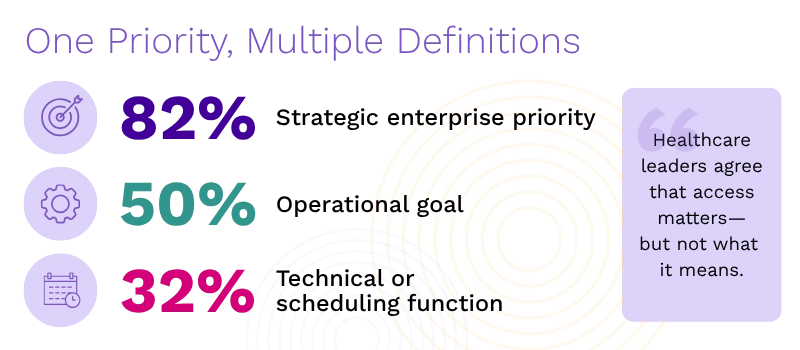
Tegria’s recent research with The Health Management Academy (THMA) found that 82% of health systems view access as a strategic pillar supporting growth, quality, and financial performance. At the same time, many continue to struggle with core challenges like appointment availability, scheduling, and patient navigation.
A closer look reveals why progress can be difficult to sustain. While most leaders agree that access is important, they do not always agree on what access actually means. Half of respondents describe access as an operational goal, while nearly one-third still define it primarily as a technical or scheduling initiative. These differences may seem subtle, but they create real friction. Teams end up working toward different interpretations of the same objective.
Leadership alignment also shows gaps in how access is governed. While 93% of organizations report reviewing access strategy regularly, only 32% include finance in those discussions. That limits the ability to connect access improvements to financial performance and long-term investment decisions. Together, these gaps make it harder to translate strategy into consistent execution.
Access isn’t an isolated problem. It touches every part of the organization. Driving real change requires alignment across a wide range of stakeholders, all moving toward the same goal, even as they face different challenges along the way.
ASHLEY WHITNEYPrincipal, Care Operations
Want to see how leading health systems are approaching access transformation?
Why Access Transformation Often Stalls
Many organizations approach access transformation as a defined initiative. They launch programs, implement new workflows, and measure early results. Then focus shifts to the next priority.
In practice, improving access requires a sustained shift in how the organization operates. As Ashley Whitney explains, access transformation requires more than implementation. It involves embedding new ways of working into daily operations and reinforcing them over time. “Access transformation isn’t a project you complete,” she said. “It’s a shift to a new operating model that has to be reinforced and sustained over time.”
That shift affects how teams collaborate, how performance is measured, and how decisions are made across departments. Without that level of integration, progress can stall. Gains in one area may create new challenges in another. Teams may revert to familiar workflows that do not support broader access goals.
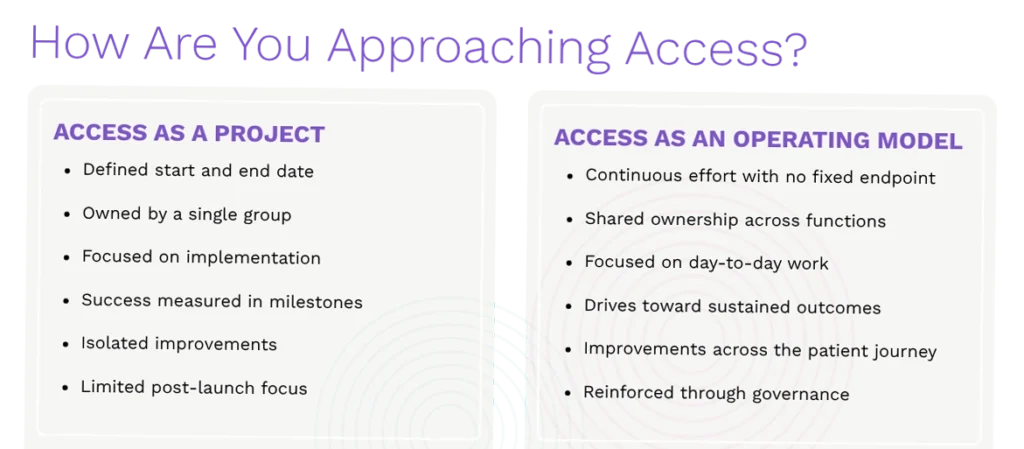
Organizations that make sustained progress treat access as an ongoing capability. They build mechanisms to reinforce alignment and adjust as conditions change.
Alignment Is the Foundation
Because access spans the enterprise, alignment is the starting point. Alignment begins with a shared understanding of what access means and what success looks like. From there, it extends to how goals are set, how performance is measured, and how accountability is shared across teams.
Without that foundation, even strong strategies struggle to take hold. Teams may focus on different priorities or measure success in ways that do not reflect the full patient experience.
Steve Nilson points out that alignment is not only about structure. It is also about how teams work together day to day. “Strong access performance comes down to governance and partnership,” he said. “It depends on whether teams feel like they are part of the solution or simply executing someone else’s plan.”
When teams feel ownership, they are more likely to collaborate, share accountability, and stay focused on the broader outcome.
The organizations that get access right have the right people at the table. More importantly, those people are aligned and working together toward the same outcome.
STEVE NILSONManaging Director, Access + Experience
From Silos to the Patient Journey
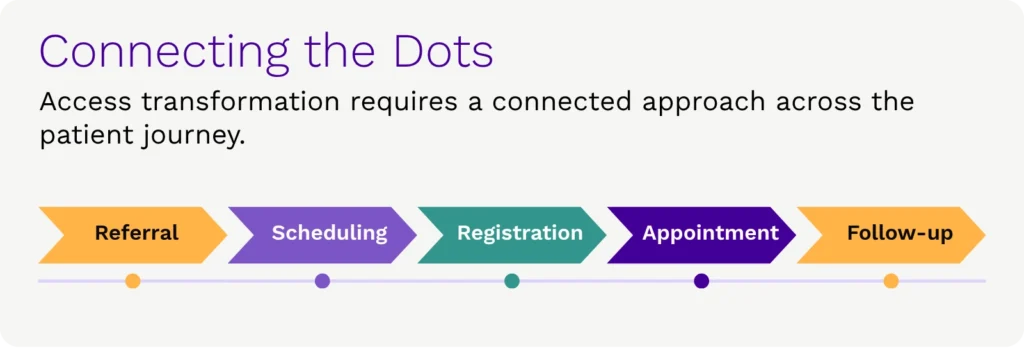
Patients do not experience access as a series of disconnected steps. They experience it as a journey that includes scheduling, registration, clinical care, and follow-up. In many organizations, these steps are managed independently. Each function focuses on its own responsibilities and metrics, often without full visibility into what happens before or after.
This fragmented view creates gaps in the patient experience. Scheduling may be efficient, but patients may still struggle to see the right provider at the right time. Information may not flow consistently between teams. Delays in one part of the process can affect the entire journey.
Improving access requires a more connected view. Organizations need to understand how each touch point contributes to the overall experience and how decisions in one area affect outcomes in another.
This shift also requires a change in mindset. Teams need to look beyond their immediate roles and understand how their work fits into the broader system. That perspective helps reinforce shared accountability and more consistent outcomes.
Governance and Accountability Still Lag
As access has risen in importance, governance structures have not always kept pace. Responsibility for access strategy is often spread across operations, IT, clinical teams, and digital functions. Without clear coordination, decision-making can slow and accountability can become unclear.
These challenges are not always visible at the outset. Organizations may begin with strong alignment; but without ongoing reinforcement, that alignment can weaken over time. Sustaining progress requires more than initial agreement. It requires clear ownership, defined decision-making structures, and consistent communication across teams.
Organizations that are further along in access transformation take a more deliberate approach. They bring together the right stakeholders, clarify roles, and create mechanisms to maintain alignment over time.
Building a Stronger Foundation
Access transformation does not begin with technology or process redesign. It begins with how people align, collaborate, and take ownership of outcomes.
Organizations that are making progress tend to focus on a few key areas:
- Define access consistently across the enterprise
Ensure all teams are working from the same understanding of access and success.
- Align goals and metrics across functions
Connect departmental performance to shared enterprise outcomes.
- Establish clear governance and ownership
Create structure and accountability that span operations, clinical, digital, and IT.
- Reinforce alignment over time
Treat access as an ongoing capability that requires continuous attention and adjustment.
The Foundation for What Comes Next
Health systems are continuing to invest in digital tools, process improvements, and data-driven capabilities to improve access. These efforts are important, but their impact depends on the strength of the foundation underneath them.
That foundation is built through alignment, shared accountability, and a clear understanding of how people across the organization contribute to access. Organizations that invest in this foundation are better positioned to translate strategy into execution and sustain progress over time.
Access starts with people. For health systems looking to move from ambition to impact, that is where transformation begins.
Explore the Full Research
Get deeper insights into how health systems are defining, enabling, and advancing access strategy.