Insight
Your Complete Guide to Healthcare IT Managed Services in 2026
This Article Covers
- Why Use a Managed Services Provider?
- What Are Healthcare IT Managed Services?
- Why Healthcare IT Managed Services Matter
- What Are the Benefits of Healthcare IT Managed Services?
- Examples of Healthcare IT Managed Services
- How To Choose a Managed Services Provider
- Best Practices for Healthcare IT Managed Services
- Ready for More?
- Tegria EHR Solutions
Let’s Talk About Healthcare IT Managed Services
Today’s healthcare leaders have more to manage: more digital tools, more applications, more patient-facing platforms, and more data along with tighter budgets and escalating compliance demands. Across the sector, back-office functions like revenue cycle are experiencing staffing shortages, even as hospitals increase investment in digital automation and tools to boost productivity.
This growing digital footprint and intensifying workload are pushing many health systems toward healthcare IT managed services. These partnerships provide the expertise, agility, and resilience needed to maintain compliance, protect operations, improve patient and clinician experience, and stabilize costs.
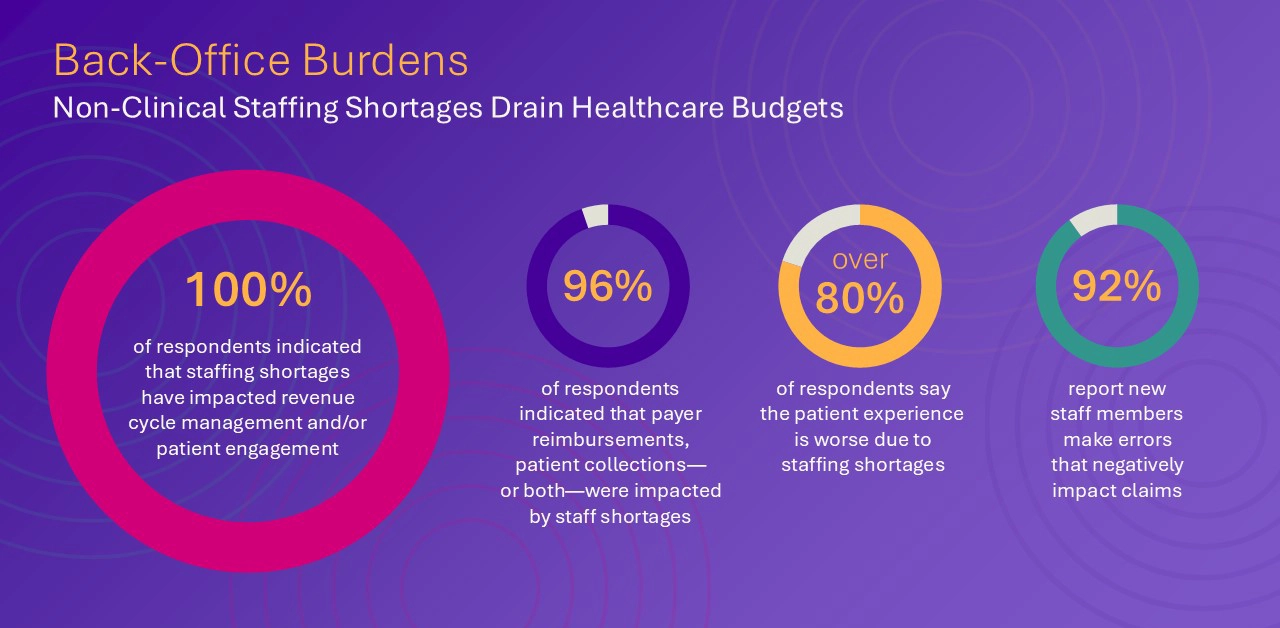
Source: Experian Health
Why Use a Managed Services Provider?
Picture this: Your hospital has just secured board approval to build a much-needed new wing. Your clinicians and staff are thrilled, but their excitement is short-lived. Rather than awarding the building contract to a construction company—preferably one specializing in healthcare—the board has chosen to assign the task to your hospital’s own facilities maintenance team.
It’s not hard to spot the problems in the board’s reasoning. While the hospital’s maintenance staff are capable and trusted, the construction of a new wing is simply beyond the capabilities of this small team. Dedicating internal staff to the new wing would mean shelving other projects and stalling the team’s ongoing work. And managing the added labor needed to complete the new wing would stretch the hospital’s leaders far too thin.
Healthcare IT leaders are faced with a similar dilemma, one that’s become increasingly urgent. Post-pandemic, healthcare organizations are facing unprecedented pressures to reduce spending. At the same time, new healthcare entrants from more consumer-driven industries like retail and technology are ramping up patients' expectations for quick, convenient healthcare at their fingertips. Healthcare organizations are racing to drive down costs as they grapple with the need to improve their technology systems.
As healthcare organizations balance budget pressures with the need to innovate, internal IT teams may be asked to support increasingly complex technology systems and projects. Soon, internal IT staff may be too bogged down to see the organization’s bigger picture. Hello, burnout, high turnover, and lagging productivity. Good luck getting any new projects off the ground, no matter how vital.
Thriving in this new era requires rethinking healthcare IT. The industry’s increasingly complex technology systems require a level of maintenance and customization that stresses many internal IT departments. Many internal IT teams simply don’t have the capacity or the specialized skills needed to manage these systems or the demands of the customers using the technology. Healthcare IT managed services providers are here to help.
What Are Healthcare IT Managed Services?
Managed services are outsourced IT services handled by a third-party managed services provider. These services can include IT operations, email, help desk, data security, or cloud hosting. The MSP is tasked with remotely monitoring, updating, and managing your IT services as part of the arrangement. The MSP’s work is guaranteed under the terms of a service level agreement (SLA), which usually covers performance metrics, like uptime and 24x7 support, as well as delivering post-event Root Cause Analysis to facilitate improvement.
Managed services are outsourced IT services handled by a third-party managed services provider. These services can include IT operations, email, help desk, data security, or cloud hosting.
Why Healthcare IT Managed Services Matter
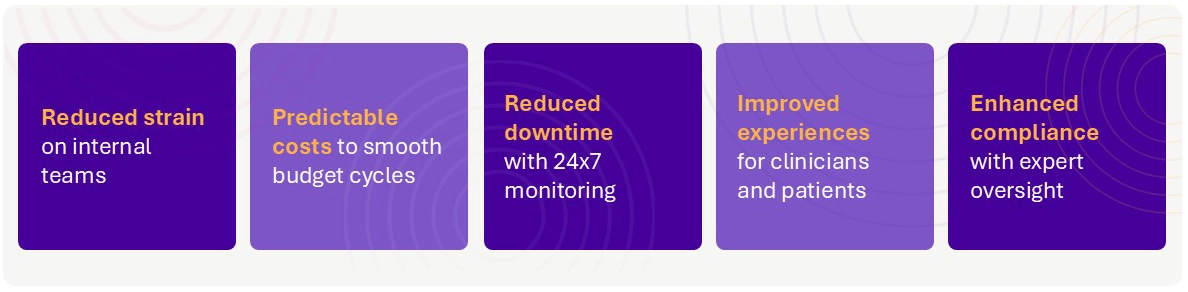
What Are the Benefits of Healthcare IT Managed Services?
More Efficient Operations
Internal teams may know your systems and goals, but trapping them in routine tasks prevents their institutional knowledge from benefiting your organization. Hiring an outside MSP to run technology systems allows the organization’s IT department to focus on the business of growing and transforming those systems, supporting system adoption, or scaling innovation. By handing over routine tasks like running the network, installing or fixing applications, managing devices, and running a 24x7 Service Desk, you free up internal staff to focus on strategic projects that further the mission of the organization.
Expert Application Support
Many healthcare leaders think of “IT support” as Help Desk: Fielding tickets and troubleshooting day-to-day issues. But in healthcare, application support is just as critical, and it deserves dedicated attention.
Core systems like MEDITECH, Epic, Oracle Health, and ancillary clinical applications are the backbone of care delivery and hospital operations. When applications aren’t supported effectively, the consequences ripple across patient care, compliance, and financial performance.
With healthcare IT managed services for application support, healthcare organizations gain round-the-clock monitoring and proactive fixes that minimize downtime and disruptions. They benefit from specialized expertise in complex clinical applications that goes well beyond the traditional Help Desk support, which translates into a better experience for clinicians who can rely on support tailored to their workflows. Managed services also make it easier for organizations to adopt upgrades and new features quickly, without adding strain to internal teams.
Improved Compliance and Risk Mitigation
Healthcare is highly regulated, and non-compliance with government requirements can result in severe financial penalties. Choosing a healthcare-specialized MSP means gaining a partner who understands evolving rules around HIPAA, interoperability, and security.
Tegria’s managed services teams have a proven track record of helping hospitals avoid penalties and stay audit-ready, reducing both risk and cost. By aligning IT operations with regulatory best practices, managed services help leaders sleep easier knowing compliance gaps are covered.
Pro Tip: Don’t settle for a generalist. A healthcare-specific managed services provider brings EHR expertise, clinical workflow knowledge, and regulatory awareness that general IT providers simply can’t match.
Customer Highlight
Montage Health – Scaling Epic Support With Tier 3 Expertise
Montage Health partnered with Tegria to elevate Epic support from Tier 2 to Tier 3, enabling the health system to scale capital projects and upgrades without overloading internal teams.
- Reduced alert fatigue by nearly half (46%–58%).
- Cut faxing errors from ~20 per day to just 4, saving 28 staff hours per month.
- Supported outreach to 117,000+ patients and achieved Epic Gold Stars 9 recognition for the fifth time.
Tegria’s support allows us to stay focused on strategic initiatives like upgrades and capital projects, without pulling resources away from operational work. It makes a significant difference in our overall capacity
SHELLI PAGE, MSN, RN, NI-BCDirector of Epic Applications, Montage Health
Examples of Healthcare IT Managed Services
Managed services include one or more components of IT service operations, which include service desk, operations management, application support, and technical management. Processes that fall under service operations include event management, incident management, problem management, request fulfillment, and access management.
For many organizations, service desk operations are the first service outsourced to an MSP. Service desk operations are tiered by complexity, with less complex service requests in Tier 1 and more complex support in Tier 3.
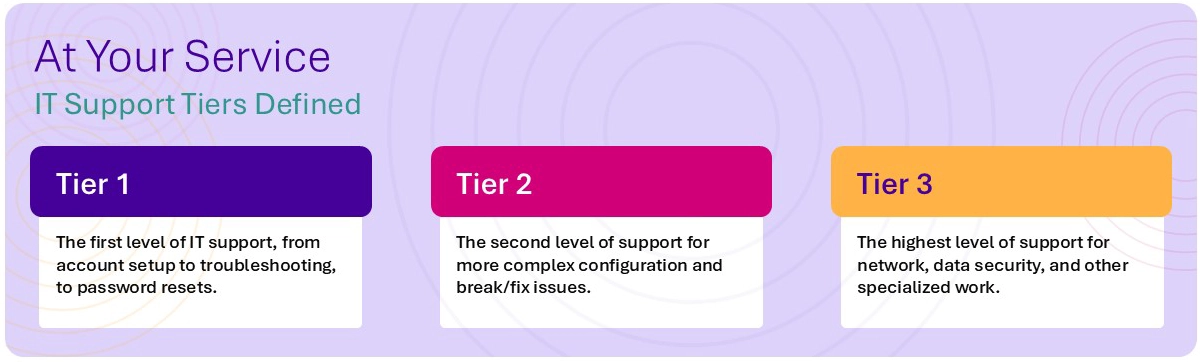
Tier 1: Help Desk Support
A Tier 1 service desk, or help desk, provides continuous coverage for routine problems, from password resets to intake management. Outsourcing your help desk also enables you to hand over the resource-intensive task of managing a contingent workforce to a managed services provider. Other features that help desk managed service providers offer include:
- 24×7 operational U.S.-based call center
- Client-branded customer satisfaction surveys
- Proactive telehealth outreach
- Patient portal support
- Built-in service recovery process
Tier 2: Service Desk Support
To elevate efficiency and accelerate operations, consider extending support beyond the Tier 1 help desk. Tier 2 support handles elevated service requests, break/fix incidents, and regular system updates. Because managing a contingent workforce with a higher level of technical skill can drain time and resources, outsourcing Tier 2 service desk support can add value to your IT strategy. An optimized Tier 2 service desk can:
- Filter up to 70% of service requests without involving analysts
- Improve efficiency nearly threefold
- Enable internal IT analysts to focus on project work and high-priority initiatives
- Increase clinician and staff productivity
- Fix IT support costs for improved financial forecasting and cost management
- Improve employee satisfaction and retention rates
Tier 3: Complex Technical Support
The highest level of technical support, Tier 3 requests include software and hardware updates, system enhancements, and design changes. Tier 3 staff often include project developers or engineers with a high level of technical skill. Some organizations choose to outsource Tier 3 support to a managed services provider, while others outsource only Tier 1 and 2 support to free internal IT staff for Tier 3 work.
A strong Tier 1 help desk can provide exceptional performance—think time-to-answer <30 seconds, 95% answer rate, email response <12 minutes, and proven best practices.
IT Operations Management
Your MSP can take on the day-to-day management of your IT infrastructure, including incident management, problem management, and the execution of operational tasks. These services can include monitoring storage, network performance, and application performance; analyzing bandwidth, traffic, and security data; and managing IP addresses, switch ports, and configuration. Outsourcing your IT operations management to a skilled MSP fuels operational efficiencies by increasing visibility across your IT infrastructure.
Application Management and Support
For many HCOs, managing an internal IT team with the technical skills needed to manage a vast and growing suite of applications is challenging, if not downright impossible. That’s when an MSP can step in. Outsourcing your healthcare application management aligns your ancillary systems and applications with your electronic health record (EHR) platform for consistent change control and proactive incident management.
A healthcare-focused MSP can manage applications specific to leading EHR platforms including Epic and MEDITECH, offering service desk support, break/fix support, and regular system updates. An MSP can also offer consulting and program management to deploy and scale new applications, optimize existing applications, and manage projects across applications. A healthcare-focused MSP can manage ancillary applications that span the entire health system, from patient access to care navigation, to radiology and diagnostics, to patient financial experience.
Cybersecurity
Healthcare data breaches doubled between 2018 and 2022, and reached a record high of 735 breaches—exposing 133 million patient records—in 2023. Partnering with an MSP for cybersecurity can help HCOs safeguard patient data and comply with privacy regulations. A cybersecurity managed services partner can offer scalable services in identity operations, vulnerability management, threat detection and response, risk management, and 24×7 incident response.
Shifting to a managed services model for cybersecurity helps HCOs shift from a reactive, incident-based approach to a proactive, strategic stance. With a partner managing daily security operations, HCOs can focus on strategic priorities and pursue innovations to help improve data security long-term. Well-managed cybersecurity services can reduce downtime and cut operating costs, help HCOs navigate an ever-evolving regulatory landscape, and access a skilled contingent workforce when needed.
Customer Highlight
San Luis Valley Health – MEDITECH Implementation, Hosting, and Long-Term Support
When San Luis Valley Health needed a smooth transition to MEDITECH, Tegria provided end-to-end support: planning, implementation, hosting, and application services.
- Delivered an on-time, on-budget deployment.
- Reduced A/R days and improved HIPAA compliance.
- Increased adoption and streamlined reporting across clinical and financial operations
They’ve been so incredibly smart, and they’ve got so much experience working with other hospitals. They’ve provided us input and value beyond anything we’ve ever experienced before.
BRIAN HEERSINKIT Director, San Luis Valley Health
Cloud Hosting
As healthcare management increasingly moves to the cloud, many HCOs choose to partner with an MSP for managed cloud services and infrastructure. Whether an organization chooses to host their data, applications, and platforms in the public cloud, private cloud, or combine cloud and on-premises resources in a hybrid model, an MSP can manage cloud services to help HCOs build, maintain, scale, and secure their cloud infrastructure. Managed cloud services can include data migration, configuration, optimization, security, and maintenance.
Partnering with an MSP to manage cloud services may involve a phased approach, starting with a focus on infrastructure, then moving on to data migration, and finally to ongoing operations management. Before migrating data and systems to the cloud, an MSP can work to build a robust cloud environment. Working with a healthcare-experienced MSP can help minimize and avoid problems associated with migrating patient data or moving healthcare applications to the cloud without interrupting operations.
Reporting
An MSP also can help you determine which types of recurring reports are needed by your organization, then handle the execution of the reports. This work covers all aspects of the reporting project, from aggregating and ingesting data, to creating reports, to managing data visualization and dashboards.
Other Managed Services
Examples of other managed services can include healthcare integration, legacy system support, data analytics, HR consulting, staff augmentation, digital workspaces (also called desktop as a service or DaaS), and wide area application services (WaaS). Your managed services provider can work with you to scale efficient managed services across your organization, expanding cost-savings and efficiency system-wide.
How To Choose a Managed Services Provider
A successful partnership with an MSP starts with clearly defined expectations and goals. Before interviewing potential MSP candidates, here are some initial questions you should consider:
- What are my biggest IT problems?
- What is the scope of the work?
- When do I need help?
- How do I want to work with a vendor—an integrated approach or a complete handoff?
- Will work take place remotely, or will you require any on-site resources?
- How will success be measured?
It’s also important to consider the long-term commitment you are making. You’ll want to ensure that potential partners are a good match culturally and that you will be able to work well together.
Choosing the Right Managed Services Provider
When it comes to specialized IT support, your managed services needs may vary depending on your EHR platform and overall digital footprint. For example, organizations using MEDITECH’s MaaS receive some vendor-provided support but often require additional services to cover gaps. Those on MEDITECH’s fully licensed model may see their support needs shaped by the choice of hosting platform.
Regardless of platform, most health systems also run dozens of non-EHR applications—everything from scheduling and billing to imaging and population health—that require ongoing support. The larger and more complex your technology environment, the more important it becomes to ensure reliable, expert coverage.
Tegria supports dozens of healthcare applications.
- Athena/ eCW
- CERMe/Midas
- Dragon/M*Modal
- HealthStream/WellSky/Compass
- rightfax/biscom
- 3M
- Badge system, badge printers, CCTV
- Workday/ADP
- PACS
- Cloverleaf/Qvera
- Tiger Text/Vocera/Voalte
- Sunquest/SoftLab
- Duo/Microsoft/Imprivata
- Kronos/ADP
- Pyxis/Omnicell
- DrFirst/EPCS
- PowerBI/Tableau
- UpToDate
- Symantec/BitLocker
- Press Ganey/SurveyMonkey
- Finesse/RingCentral
- Telehealth/Telesitting
- Citrix/VMWare
- NextGen/Centricity/Oracle Health
As EHRs and healthcare applications evolve to incorporate advanced capabilities like AI, business intelligence, and predictive analytics, IT support demands grow more specialized. That’s why it’s critical to select a healthcare-specific managed services partner. Unlike general IT providers, a healthcare-focused MSP understands the nuances of clinical workflows, compliance requirements, and the fast-changing regulatory landscape. Choosing a partner with deep healthcare expertise ensures your IT support can scale seamlessly across systems and applications to meet growth, special projects, and future innovation.
How Should Organizations Prepare To Partner With MSPs?
Defining Goals and Objectives
When considering a major investment like engaging an MSP, an HCO needs to think about the volume and scale of their operations team. Having discussions with key stakeholders across business lines and mapping out the goals, objectives, and requirements is a good place to start when considering an MSP. These may include:
- Better uptime of systems
- Improved security posture
- Access to cutting-edge knowledge and strategies
- Ability to work with cloud solutions
- Reduced IT costs over time
- Increased customer satisfaction
- More financial flexibility
- Expediting CapEx depreciation and amortization
- Reducing talent acquisition and departure risk
Staffing Considerations
You can’t talk about healthcare IT managed services without discussing the impact on internal IT staff. Will they be replaced by the MSP or become a part of the MSP? How can leaders divide the roles and responsibilities? One model is to hand over the day-to-day system maintenance to an MSP, allowing your IT team to focus on innovation and optimization. Internal analysts can spend more time on high-priority projects and less time on daily break/fix incidents, which leads to happier employees, smoother operations, and reduced costs.
Another model involves rebadging existing IT employees. In this scenario, a vendor hires the organization’s IT employees, and those employees continue working on the organization’s IT systems. This allows the organization to retain skilled IT employees and continue uninterrupted operations while reducing IT spending.
Budget Considerations
Can a managed services provider help your organization meet its financial goals? Calculating the budget benefits of contracting with a managed services provider requires first asking yourself a few questions. How much are you losing due to inefficiencies in your systems and workflows? How much could you potentially save with better integration, increased automation, and a more productive workforce? And how could outsourcing your IT help fuel innovation and efficiency?
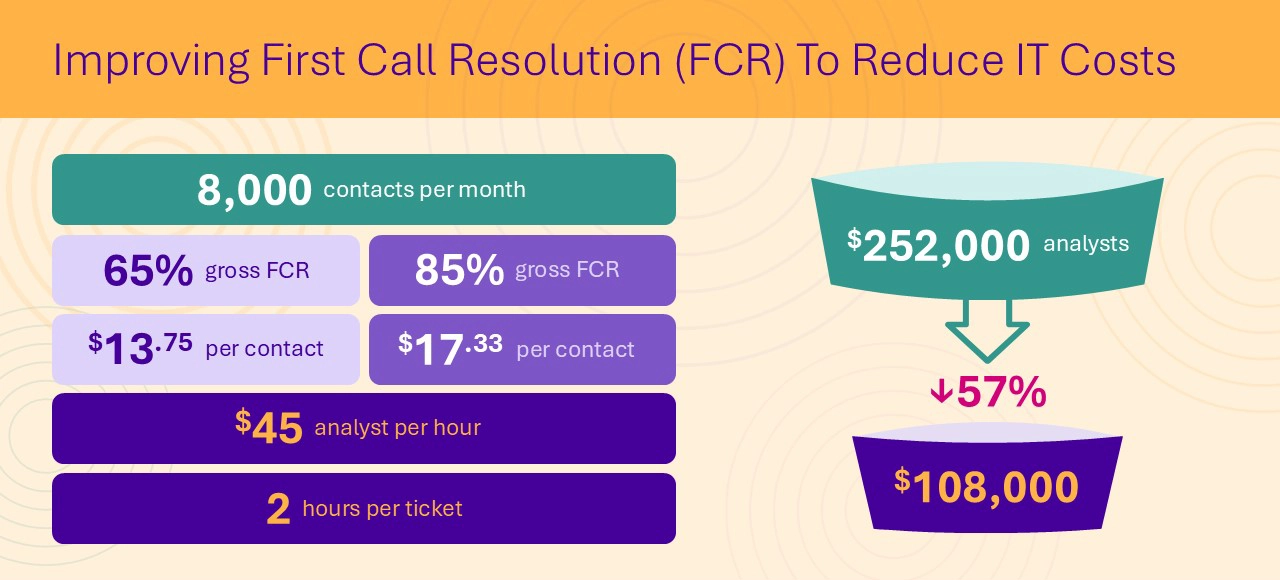
One way to view potential cost savings is to calculate how much you could save by increasing first call resolution (FCR), the number of support calls that are resolved without involving an analyst. By improving FCR, HCOs can reduce costly analyst hours and the overall operating costs for its service desk. While healthcare organizations typically achieve 65%-70% FCR on their own, managed services providers who specialize in this type of support often achieve FCR rates of 85%, 90%, or even 95%.
Let’s take a typical call center that handles 8,000 calls per month with a 65% FCR rate. The remaining 35% of its calls are escalated to an analyst who spends an average of two hours on the ticket, at a labor cost of $45 per hour. By improving its FCR rate to 85%, the organization can reduce costly analyst hours by 57% for a savings of $144,000.
Best Practices for Healthcare IT Managed Services
One of the first challenges organizations face is overcoming the negative perceptions sometimes associated with outsourcing. Clear, transparent communication about the goals and benefits of managed services helps reduce fear and anxiety. In practice, most internal IT teams benefit from the transition. Some may even join the MSP through rebadging, gaining access to broader career opportunities, competitive benefits, and a stronger support network. A capable MSP will also guide your organization through the change management process, ensuring that staff feel supported throughout.
A thorough cost-benefit analysis is another essential step. Look closely at both the immediate costs of the transition and the long-term savings and efficiencies it will create. Some benefits, like improved staff satisfaction or reduced risk, may be less tangible but are just as important to factor into the overall picture.
Best Practices at a Glance
- Communicate clearly to ease concerns
- Run a cost-benefit analysis up front
- Set scope and success metrics early
- Lean on MSP expertise for change management
- Roll out in phases to reduce disruption
- Establish recurring check-ins to stay aligned
- Foster collaboration between IT and MSP teams
Success also depends on setting clear expectations from the outset. Define the metrics you’ll use to measure progress, determine the right timeline for going live, and establish how incremental improvements will be handled. Agreeing on scope, responsibilities, and success measures upfront helps minimize surprises and makes problem-solving easier when challenges arise.
Ultimately, managed services allow healthcare organizations to focus on their mission. Just as you wouldn’t ask your facilities team to design and build a new hospital wing, you shouldn’t expect internal IT staff to simultaneously deliver everyday support, customer service, advanced application management, cybersecurity, and cloud infrastructure. Partnering with an experienced MSP ensures that technology is expertly managed, freeing your organization to invest in the innovations that patients and providers need most.
Ready to build a productive managed services partnership?
Frequently Asked Questions About Healthcare IT Managed Services
What are healthcare IT managed services?
Healthcare IT managed services are outsourced support solutions that help hospitals and health systems manage their technology environments. Unlike general IT managed services, healthcare-specific offerings are designed to support clinical workflows, EHRs, and regulatory requirements. Services may include Help Desk, application support, infrastructure management, cloud hosting, and security monitoring.
How do managed services benefit healthcare organizations?
Managed services provide hospitals and health systems with predictable costs, 24x7 monitoring, and access to specialized expertise. By outsourcing IT operations, organizations can:
- Reduce downtime and system outages.
- Improve clinician and patient experiences.
- Strengthen compliance and security posture.
- Free up internal staff to focus on strategic initiatives.
What’s the difference between Help Desk and application support?
Help Desk services typically handle Tier 1 tickets such as password resets, device issues, and user access problems. Application support goes deeper, managing the functionality and optimization of core clinical systems like Epic and MEDITECH. Effective application support ensures that upgrades, integrations, and workflow improvements are fully adopted across the organization.
How can managed services reduce compliance risk?
Healthcare is subject to strict regulations, including HIPAA, HITECH, and interoperability standards. Managed services partners with healthcare expertise proactively monitor systems, apply updates, and align workflows with compliance requirements. This reduces the risk of fines, penalties, or failed audits while improving data protection and security.
Why is it important to choose a healthcare-specialized MSP?
General IT providers may lack knowledge of EHR systems, clinical workflows, and healthcare regulations. A healthcare-specialized managed services provider brings experience with clinical end-users, understands the unique needs of providers and payers, and ensures IT solutions align with patient care priorities and compliance requirements.