Insight
Navigating to Value-Based Care
Are You Prepared To Succeed?
Value-Based Care Participation Is Increasing
The healthcare industry is rapidly transforming, driven primarily by the Centers for Medicare and Medicaid Services (CMS) and its commitment to value-based care.
As of 2025, approximately 13.7 million Medicare beneficiaries were aligned to Accountable Care Organizations (ACOs), growing to 14.3 million in 2026. This increase reflects continued expansion across CMS accountable care models, including the Medicare Shared Savings Program (MSSP), alongside recent policy changes designed to encourage participation.

The State and Science of Value-based Care 2025 found that over 60% of organizations increased their participation in VBC programs. However, time is critical for those who have not yet adapted. The CMS plans to move away from fee-for-service models, replacing them with value-based initiatives that connect reimbursement to quality metrics and patient outcomes. This commitment is underscored by an ambitious goal for 2030: to enroll all Medicare and Medicaid beneficiaries in accountable care arrangements.
The pressing question is no longer whether this transition will happen but how prepared your organization is to navigate the shift from voluntary to mandatory participation models.
Access: The "Last Mile" of Value-Based Care
To succeed in accountable care arrangements, health organizations must transition from reactive scheduling to proactive patient orchestration. Recent research reveals that the most successful organizations are already making this shift:
- 82% of health systems now position access as a core strategic pillar, placing it on par with quality and finance.
- Access is now viewed as an essential component that connects clinical care to business imperatives like payer mix and reducing network leakage—both critical for VBC success.
- A Systemwide Capability: Leading systems no longer see access as a series of operational fixes but as a systemwide capability that integrates clinical, operational, and digital functions.
- Despite these goals, 62% of systems report that appointment availability and wait times remain their largest execution gap. Closing this gap is essential to meeting the CMS 2030 mandate for coordinated care.
- Organizations are increasingly investing in the "digital front door" to support this transition, with 65% investing in digital navigation tools and 61% in AI-powered communications.
Understanding the Motivation Behind the Transition
The CMS’s 2030 goal emphasizes the urgency for healthcare organizations to align their strategies with the principles of value-based care. Recent updates, including the launch of the "Making Care Primary" (MCP) model in 2024 and the "ACO Primary Care Flex" model in 2025, prioritize quality over quantity by focusing on patient outcomes and cost efficiency rather than the number of visits. They transform how care is delivered, measured, and reimbursed.
Transitioning to this new model brings both opportunities and challenges. Value-based care can lead to better outcomes by lowering the likelihood "of beneficiaries' forgoing" care due to cost. Furthermore, CMS has introduced "Health Equity Adjustments," providing higher benchmarks and financial incentives for providers serving underserved populations. Programs like Accountable Care Organizations (ACOs) and the Medicare Shared Savings Program (MSSP) are leading the way in this transition, and the results are promising. In 2024, the MSSP achieved its highest savings to date, marking seven consecutive years of cost reductions for Medicare while expanding access to specialized care.
Key Considerations for Value-Based Care
The move to value-based care requires healthcare organizations to rethink their fundamental approach to care delivery. Success hinges on meeting stringent quality metrics, improving care coordination, and controlling costs. Key areas to consider include:
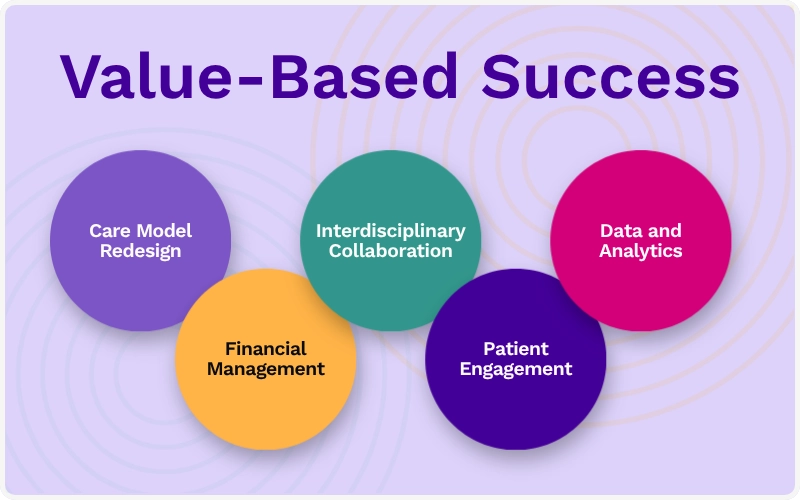
- Care Model Redesign: Value-based care focuses on whole-person care and preventive services. Organizations must move from reactive, episodic care to proactive, coordinated care that addresses patients' physical, emotional, and social needs. In 2024 and 2025, CMS has placed a specific emphasis on integrating behavioral health and palliative care into primary care workflows. Organizations must now standardize the collection of Social Determinants of Health (SDOH) data. CMS priorities now mandate screening for food insecurity, housing instability, and transportation needs as part of core quality reporting.
- Financial Management: The transition to value-based care often requires upfront investments in technology and training. Healthcare leaders must ensure that their organizations are financially prepared to make these changes. However, CMS has introduced Advance Investment Payments (AIPs) for eligible low-revenue ACOs—particularly those in rural and underserved areas—providing upfront funding to support the infrastructure, staffing, and care coordination capabilities needed for success in value-based care.
- Interdisciplinary Collaboration: Value-based care requires collaboration between physicians, care managers, IT teams, and administrative staff. Building a culture of teamwork and shared accountability is critical when things like leveraging AI-driven predictive analytics to identify high-risk patients before they require hospitalization is now a competitive necessity.
- Patient Engagement: Empowering patients to take an active role in their care is a cornerstone of value-based care. This involves improving communication, offering education, and providing tools that enhance self-management.
- Data and Analytics: Robust data systems are essential for tracking quality metrics, identifying care gaps, and measuring performance. Organizations need the tools and expertise to analyze and use data effectively for informed decision-making.
Are You Ready for the Transition?
Given the scope of these changes, assessing your organization’s readiness for value-based care is essential. Questions to consider include:
- Do you have systems to track and report on digital quality metrics (eCQMs) effectively?
- Are your care delivery models aligned with whole-person care principles?
- Is your organization fostering a culture of collaboration and accountability?
- Is your organization prepared to take on "downside risk," which CMS is increasingly requiring for long-term participation?
- Do you have the technology and analytics capabilities to support data-driven decision-making?
- Do you understand the financial implications of transitioning to value-based care?
Taking the First Step
The shift to value-based care is not just a regulatory mandate; it’s an opportunity to improve patient outcomes, reduce costs, and build a more sustainable healthcare system. However, achieving these goals requires a proactive approach.
As CMS continues to expand investments in primary care, health equity, and accountable care models in 2025, organizations are under increasing pressure to modernize care delivery infrastructure, deepen cross-sector partnerships, and embed continuous improvement into day-to-day workflows.
For those feeling unprepared, now is the time to act. Whether conducting a readiness assessment, identifying care delivery gaps, or investing in advanced analytics, every step taken today will position your organization for success in the value-based care era.