Insight
BCA Best Practices: 4 Strategies for Success With MEDITECH Business and Clinical Analytics
MEDITECH Expanse is heralded for its modern, web-based design that emphasizes ease of use with user-friendly and intuitive digital tools.
Business and Clinical Analytics (BCA) is a great example, as this web-based data storytelling tool makes it easy to visualize performance and outcomes using real-time data from within and outside the EHR. Even better—it comes with robust, pre-built data sets and can provide actionable analytics right out of the box to help healthcare organizations improve operations and financial performance.
As healthcare organizations face growing pressure to succeed under value-based care models, analytics platforms like BCA play a critical role in tracking quality metrics, managing risk, and aligning clinical and financial performance.
#1: Cultivate a Culture of Data Democratization
Gone are the days when only a select few employees could decipher complex data outputs to gauge organizational performance. When it comes to analytics, unwieldy spreadsheets are being replaced with data visualization tools like BCA that provide meaningful insights and don’t require a data engineering background to understand. BCA is a self-service empowerment tool that can transform the way non-technical staff use and share data.
In today’s complex landscape, this empowerment is a strategic imperative; as highlighted in the HIMSS25 trends, robust data systems are now essential for healthcare leaders to navigate policy uncertainty and optimize organizational budgets.
Encourage end users who might be intimidated by data analytics to embrace BCA’s user-friendly features with regular communication before, during, and after your BCA implementation. Share demos and use cases with staff to help them understand its value and how it will make their teams and organizations more efficient and effective. MEDITECH’s website offers a number of examples detailing how organizations have used BCA to unlock efficiencies and improve the quality of care.
Foster a Data-Driven Culture
Tegria provides comprehensive change management, targeted training, and executive alignment strategies to bridge gaps between technical teams and business stakeholders for widespread data adoption and success.
#2: Define Your User Roles and Prioritize Training
Early and ongoing training is essential to ensure a positive experience and sustained user adoption However, training is more than an educational goal—it is a core business continuity strategy. By cross-training multiple “Super Users” across different departments, you mitigate key-person risk and ensure that critical clinical insights remain uninterrupted during staffing transitions or leaves of absence.
We recommend small class sizes with customized training from introductory to advanced levels. Resources for your BCA implementation can be broken into three main groups:

- Cheerleaders: Identify key, visible members at your organization with a solid understanding of, and enthusiasm for, BCA. These team members can serve as a central point for communication of benefits and team member concerns.
- Super Users:
- Dashboard/Dossier Creators: Super users who manipulate data.
- Dataset Creators: Super users, often programmers, who build custom datasets and create initial dashboards for others.
- Core Teams: These are your consumers who need data in an easy-to-use format and may not want extensive customization.
#3: Data Integrity Is Essential for Trust
Data-driven decisions hinge on accurate, reliable data and on end-user trust. To gain both, it’s important to establish a culture of data awareness, responsibility, and governance to protect and leverage data effectively. Your data should be a reliable source of truth, and its integrity ensured with quality control ownership and continuous validation. Backup and recovery plans, data access controls, and end-user training and awareness all play a vital role in achieving reliable, clean data.
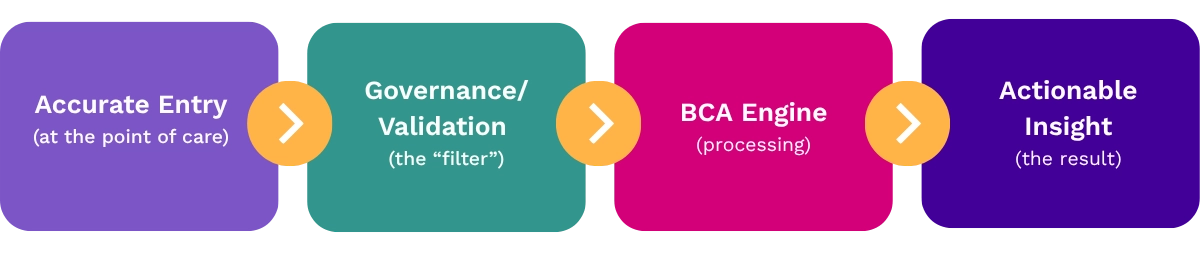
Time and again, I find myself giving customers the simple advice that good data in leads to good data out. Data integrity is essential to gain end-user trust and continued engagement.
ROBYN WHELCHELSenior Managing Consultant, Enterprise Systems, Tegria
#4: Know What To Avoid
Every healthcare organization is unique with its own mix of technology, processes, and challenges. However, a few common roadblocks apply to nearly every stagnant BCA implementation, including:
- Ambiguous Entry Points: Clearly define where to begin the implementation process by identifying a starting point as a soft launch or analyzing data to prioritize certain departments or initiatives during rollout.
- Silos and Information Hoarding: As mentioned earlier, change can be hard. A new system and processes for BCA can spark leadership and end-user concerns around data sharing and transparency. Regularly communicate with all stakeholders (employees, patients, partners, etc.) about how transparent data sharing improves patient outcomes. It will help alleviate fears and build trust.
- Overreliance on IT: Avoid placing too much responsibility on your IT department by involving other stakeholders in the implementation. A collaborative approach involving clinical and operational leaders provides operational redundancy. This ensures your analytics strategy isn’t vulnerable to a single point of failure and reflects the “big picture” needs of the entire organization.
Today’s leading organizations are moving beyond retrospective dashboards toward predictive and prescriptive analytics. By layering AI and machine learning capabilities onto tools like BCA, teams can proactively identify at-risk patients, forecast operational bottlenecks, and surface insights in real time—before issues escalate.
Learn more about succeeding with BCA. Watch our BCA Pathway to Success Webinar.
Get Analytics-Ready
Tegria can help you prepare the essential foundation for effective analytics, AI, and robust decision support. We address crucial aspects like data quality, lineage, cataloging, and integration to accelerate your time-to-value for both standard reporting and advanced analytical capabilities.