Insight
Managed Services for Community Hospitals: Extending Teams and Improving Performance
Community hospitals and Critical Access Hospitals are facing increasing operational pressure. Financial margins remain tight, workforce shortages continue across clinical and operational roles, and technology environments are becoming more complex. At the same time, healthcare organizations are expected to improve performance, strengthen financial stability, maintain compliance, and support staff with limited internal resources.
For many hospitals, the challenge is not identifying what needs improvement. The challenge is having the bandwidth and specialized expertise required to support those priorities consistently over time.
That reality is driving more community hospitals to adopt healthcare managed services as part of their long-term operational strategy. Managed services help organizations extend internal teams with experienced healthcare specialists who can support critical operational and technology functions while improving stability, efficiency, and performance.
Healthcare managed services can support a wide range of organizational needs, including:
Managed IT Services
- Infrastructure management
- Cloud hosting
- Application hosting
- System monitoring
- Managed security
- Tiered help desk and support
Managed Application Services
- MEDITECH support
- EHR optimization
- Release management
- Application maintenance
Managed Operational Services
- Revenue cycle services
- Coding support
- Reporting and analytics
- Regulatory reporting
For community hospitals operating with lean internal teams, these services provide access to specialized expertise without requiring large increases in headcount or overhead.
Why Community Hospitals Are Expanding Managed Services Models
Community hospitals often operate with limited staffing flexibility. Internal teams support a wide range of responsibilities, and recruiting experienced healthcare IT, revenue cycle, analytics, and application support talent can be difficult, particularly in rural markets.
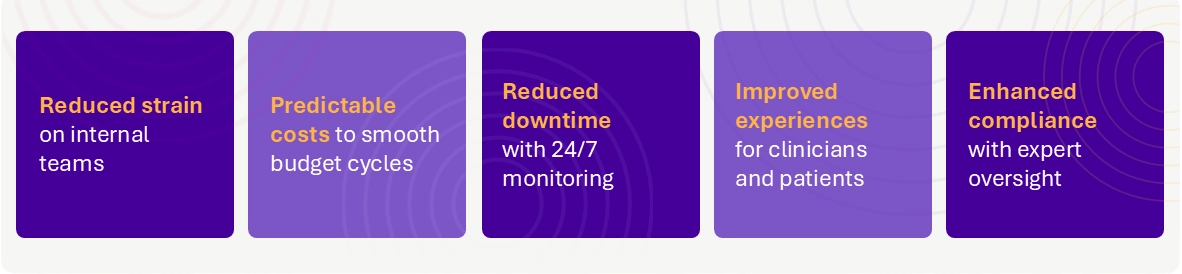
Operational demands also continue to grow. Revenue cycle teams are expected to reduce denials and improve reimbursement performance. IT teams are responsible for supporting increasingly complex technology environments while maintaining cybersecurity, uptime, and user support. Reporting and analytics teams must deliver accurate operational and regulatory reporting while helping leadership teams make informed decisions.
Maintaining deep expertise across all of these areas internally is challenging for organizations of any size. For community hospitals, it can place significant strain on existing teams and create operational risk when staffing gaps occur.
Managed services help organizations strengthen support in key operational areas while giving internal teams greater capacity to focus on strategic priorities and patient care operations.
Client success
Pender Community Hospital
Pender faced challenges in achieving financial and operational efficiency due to complex payer rules and a lack of proper tools. Tegria took on Pender’s revenue cycle management functions, including billing, coding, revenue integrity, cash management, and leadership.
- Gross days in A/R dropped by more than half year over year
- Insurance denial rates declined by more than 71% compared to the previous year
- Cash collection increased from an average of $1.5 million per month to $2.8 million per month
Tegria’s expertise was instrumental in transforming our revenue cycle management. Their collaborative approach and deep understanding of MEDITECH’s capabilities enabled us to streamline workflows and enhance financial performance.
LAURA GAMBLECEO, Pender Community Hospital
Where Managed Services Can Deliver Immediate Value
Revenue cycle operations are one area where managed services can create measurable impact quickly. Additional support in billing, coding, denial management, A/R optimization, and collections can help hospitals improve cash flow, reduce administrative burden, and strengthen financial performance.
For organizations using MEDITECH, specialized expertise is often especially valuable. Community hospitals frequently struggle to recruit and retain experienced MEDITECH analysts, developers, and operational specialists. Managed application services provide access to experienced resources that can help optimize workflows, support releases, improve user support, and maintain system performance over time.
Managed reporting and analytics services are becoming increasingly important as reporting requirements continue to expand. Many hospitals operate with limited internal reporting resources while managing growing demands around operational reporting, regulatory requirements, dashboard development, and data access.
Additional reporting support can help hospitals improve visibility into operational and financial performance while reducing pressure on internal IT and analytics teams. Access to timely, accurate data also helps leadership make decisions more confidently and respond more quickly to operational challenges.
Technology managed services also play an important role in supporting operational stability. Hosting, infrastructure management, monitoring, and tiered support services can help hospitals improve reliability, strengthen security, and reduce the day-to-day burden on internal IT teams.
Client success
San Luis Valley Health
When San Luis Valley Health needed a smooth transition to MEDITECH, Tegria provided end-to-end support: planning, implementation, hosting, and application services.
- Delivered an on-time, on-budget deployment
- Reduced A/R days and improved HIPAA compliance
- Increased adoption and streamlined reporting across clinical and financial operations
They’ve been so incredibly smart, and they’ve got so much experience working with other hospitals. They’ve provided us input and value beyond anything we’ve ever experienced before.
BRIAN HEERSINKIT Director, San Luis Valley Health
Managed Services as a Long-Term Operational Strategy
Managed services have become an increasingly practical strategy for community hospitals looking to strengthen operations while managing limited resources responsibly. The goal is to create sustainable operational support models that help organizations maintain momentum over time.
Successful managed services relationships depend on healthcare-specific expertise, operational alignment, and a clear understanding of how hospitals function day to day. Community hospitals benefit most from partners who understand the realities of healthcare operations, staffing constraints, reimbursement pressures, and EHR environments like MEDITECH.
As operational and workforce challenges continue across healthcare, managed services can help community hospitals extend internal capabilities, improve performance, and build greater operational resilience for the future.