Insight
Your Guide to CMS-0057-F Compliance
How payers can manage the 2026 mandates and prepare for 2027 API deadlines
CMS-0057-F at a Glance
The Interoperability and Prior Authorization Final Rule (CMS-0057-F) introduced new requirements for Medicare Advantage, Medicaid, CHIP, and Qualified Health Plan (QHP) payers on the Federally Facilitated Exchange (FFE). The rule aims to reduce delays in care, improve data exchange, and enhance transparency.
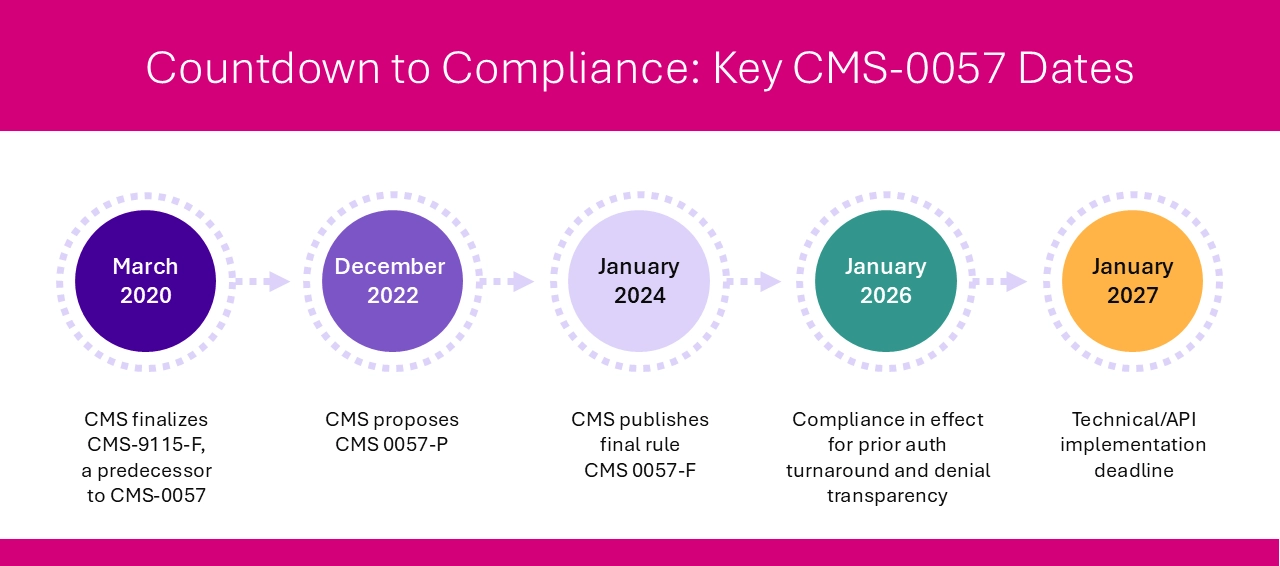
Affected payers must now maintain compliance with operational changes that took effect on January 1, 2026, while continuing to work toward the FHIR API implementation and reporting requirements due by January 1, 2027. To prepare, payers should focus on four key categories: data exchange between payers, enhanced patient data access, interoperability with in-network providers, and streamlined prior authorization processes.
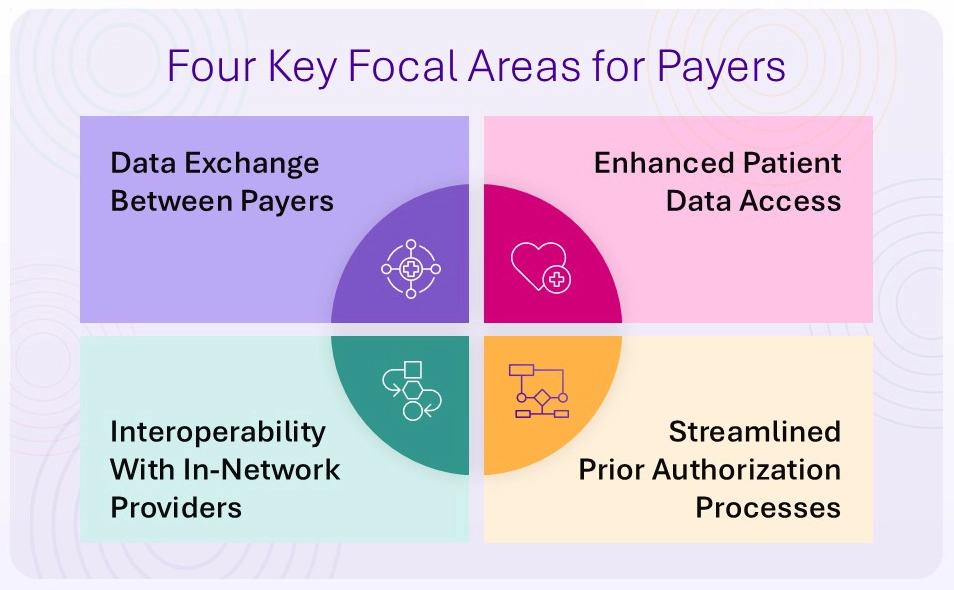
Four CMS-0057-F Requirements Payers Must Address
1. Payer-to-Payer Data Exchange
To support care continuity and reduce duplication, payers must exchange patient data—such as claims, encounters, and prior authorization decisions—when a member switches plans. This exchange must happen via a FHIR-based API and at the member’s request.
- For members with concurrent coverage, payers must share relevant data at least quarterly.
- Financial data remains excluded.
- The goal: a longitudinal health record that follows the patient from plan to plan.
2. Expanded Patient Access API
Building on the 2020 CMS interoperability rule, CMS-0057-F requires payers to expand the Patient Access API to include prior authorization information.
This means patients must be able to access:
- Whether prior authorization is required
- Documentation requirements
- Status and decisions on prior authorization requests
This supports informed decision-making and greater transparency for patients managing their own care.
3. Enabling Value-Based Care with the Provider Access API
To support value-based care and timely treatment decisions, payers must share clinical and administrative data with in-network providers via a new Provider Access API. This includes:
- Claims and encounter data
- Prior authorization request statuses and decisions
Importantly, patients must have the option to opt out of this data sharing and must be notified of this choice.
4. Prior Authorization API and Operational Improvements
CMS-0057-F introduces both technical and operational requirements to improve the speed, transparency, and automation of prior authorization workflows.
API Requirements (due by January 1, 2027):
Payers must implement a FHIR-based Prior Authorization API that allows providers to:
- Determine if prior authorization is required
- Submit requests and supporting documentation electronically
- Receive prior authorization decisions through EHRs or practice management systems
The ANSI X12 278 standard continues to be supported for back-end transmission.
Current Operational Requirements (effective January 1, 2026):
- Mandated turnaround times: Decisions must now be issued within 72 hours for urgent requests and 7 calendar days for standard requests.
- Detailed denial reasons: must be included to enable quick resubmissions
Five-year data availability: prior authorization history must be retained and shared upon request
Key Insight: Currently, 62% of health system executives cite appointment availability and wait times as their greatest gap between aspirations and execution. Streamlining prior authorizations through these APIs is essential to closing that gap.
Public reporting: beginning in 2027, payers must publish prior authorization metrics including total requests, approvals, denials, and average processing times. These updates represent major CMS regulatory changes designed to speed up approvals and create consistency across payers.
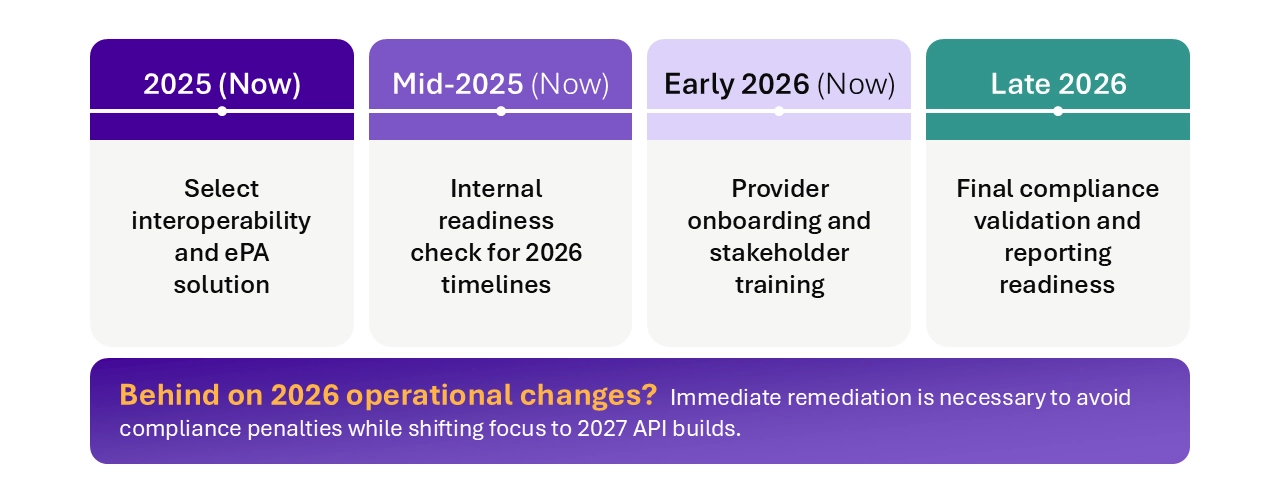
Planning Milestones for Payers
Looking for more provider-focused CMS-0057-F guidance?
How To Plan for Success
With the final 2027 technical deadline approaching, payers need a focused strategy for both maintaining current compliance and completing API builds. Key steps include:
Choose the right interoperability solution
Ensure your platform:
- Supports all four required APIs (Patient Access, Provider Access, Payer-to-Payer, Prior Authorization)
- Meets HL7® FHIR® technical standards
- Aligns with your data infrastructure and provider network needs
Build the right team
This is not an IT-only initiative. Bring together cross-functional experts in:
- Electronic prior authorization and FHIR APIs
- Business intelligence and metrics reporting
- Provider relations and onboarding
- Claims and eligibility systems
Think beyond compliance
Leverage interoperability to improve care coordination, reduce administrative burden, and enhance member and provider experience. For example:
- Automated chart retrieval and electronic release of information (ROI) can accelerate medical necessity reviews.
- Integration with downstream systems can reduce redundant work and manual handoffs.
Collaborate early with providers
Understand that 71% of health system executives currently view "payer dynamics" as a dominant external force stalling their patient access transformation. It’s important to know provider workflows and explain how your APIs can reduce their administrative overhead. Provider buy-in will be essential to realizing the intended benefits of interoperability.
- Engage early
- Test workflows
- Adjust based on reality - not assumptions
Explore detailed guidance for payers and providers.
CMS-0057-F Action Steps
- Conduct a full compliance gap assessment
- Align IT, compliance, and operations teams
- Select or validate your FHIR/API platform
- Redesign prior authorization workflows
- Implement faster decision timelines
- Build provider integration strategy
- Develop CMS reporting pipelines
- Test everything before 2027 deadlines
The Bottom Line
CMS-0057-F sets the stage for a more transparent, efficient, and interoperable healthcare system. For payers, these changes are not just a regulatory burden—they’re an opportunity to modernize infrastructure, strengthen provider partnerships, and enhance the member experience.
Is your organization meeting the current 2026 mandates while preparing for the 2027 technical leap? The time to act is now. Whether you’re on track or falling behind, we’re here to help you meet your goals. Contact us to speak with an expert.
Wherever you are on your interoperability journey, Tegria can help.

Whether you’re just getting started, ready to move to the cloud, or somewhere in between, we'll meet you where you are, guiding you on your journey toward achieving operational readiness, collaborative provider payer relationships, and realization of ROI.