Case Study
Advancing Care Quality and Value-Based Performance at Arrowhead Regional Medical Center
- Challenge: Arrowhead Regional Medical Center (ARMC) needed to enhance care consistency and clinical quality to meet rigorous value-based care and performance benchmarks tied to patient outcomes.
At a glance
Arrowhead Regional Medical Center
- Facility: Teaching hospital
- Location: San Bernardino County, California
- EHR: Epic
- Services Provided: Care model redesign, workflow optimization, clinical quality improvement, data analysis and reporting
Key Outcomes
- Increased POCT A1C completion to over 80%, surpassing improvement targets early.
- Completed over 5,000 diabetes outreach calls and generated over 2,500 appointment requests.
- Implemented a sustainable POC testing workflow without additional staffing.
Our care model redesign with Tegria helped us realign workflows and empower our teams to work at the top of their scope. With Tegria’s help, we built efficient, sustainable processes that fit naturally into our clinics’ daily routines. By making simple but strategic workflow changes, we achieved measurable improvements in diabetes care and patient outcomes.
BRANDY ARTHURVP/Associate Hospital Administrator, Arrowhead Regional Medical Center
Background
ARMC recognized the need to better align clinical workflows with top-of-license practice and evidence-based standards. Nearly half of diabetic patients were missing A1C lab draws, and many lacked recent medication adjustments or primary care follow-up. To ensure high-quality care and position the organization for success under value-based care arrangements and annual HEDIS reporting, ARMC required greater consistency in clinical practice and improved visibility into care gaps.
Solution
Tegria partnered with ARMC to implement a Care Model Redesign initiative focused on improving workflow consistency, care gap visibility, and team performance. The project began with a detailed discovery assessment of existing workflows, followed by development of new POC A1C testing competencies, standardized ordering protocols, and a weekly “missed opportunities” report. Clinic managers received ongoing education and structured pulse checks to ensure these changes became integrated into daily practice.
Tegria’s approach included:
- Conducting a comprehensive workflow discovery and gap analysis
- Developing standardized competencies for POC A1C testing
- Creating and implementing consistent ordering and documentation protocols
- Establishing a weekly “missed opportunities” report to improve visibility into care gaps
- Providing ongoing education, structured pulse checks, and coaching for clinic managers
- Embedding redesigned workflows into daily operations without adding staff
Results
ARMC met and sustained its diabetes quality measure (A1C <9) months ahead of annual VBC and HEDIS deadlines, demonstrating significant improvements in care quality and consistency. POCT A1C completion rates exceeded 80%, surpassing both interim and final goals ahead of schedule.
Through improved workflows and targeted outreach, ARMC completed more than 5,000 diabetes-related patient calls and generated over 2,500 appointment requests. The organization also implemented a sustainable POC testing workflow that required no additional hires, enabling teams to work more efficiently and consistently at the top of their scope.
Case Study
Accelerating Value, Reducing Risk: SLUHN AI Innovation Lab
- Challenge: Facing growing operational and financial pressure and an influx of AI vendors, SLUHN needed a governed approach to validate AI value before committing to large-scale investments.
At a glance
St. Luke’s University Health Network
- Facility: Nonprofit health network
- Location: Bethlehem, Pennsylvania
- Services Provided: AI Innovation Lab design and facilitation, proof-of-concept (POC) execution, AI and advanced analytics evaluation, digital workforce assessment and prototyping, data integration and governance guidance, and enterprise AI roadmap development
Key Outcomes
- Launched a governed AI Innovation Lab to safely evaluate and prioritize AI use cases
- Validated platform-driven alternatives to AI vendors
- Demonstrated the feasibility of a Digital Workforce for financial operations
- Delivered clear go / no-go decisions and scalable AI roadmaps
Through the Innovation Lab, we explored early-stage AI concepts related to documentation, abstraction, and operational workflows in a controlled, governance-focused environment. While the work was exploratory in nature, it provided valuable insight into potential opportunities and considerations as we continue to thoughtfully evaluate this emerging technology.
CHERYL DAVIDSON,MSN, RN, Sr. Network Director, Data Abstraction & Registry Services
Background and Challenge
Like many large health systems, St. Luke’s University Health Network (SLUHN) faced growing operational and financial pressures alongside a surge of AI vendors promising automation across revenue cycle, patient access, registries, and contract management. While leadership recognized the potential of AI and advanced analytics, they also faced significant risks:
- High uncertainty and risk in committing to multi-year AI platform investments without clear evidence of value, data readiness, or workflow fit
- Vendor overload, with limited internal capacity to objectively compare “build vs. buy” options or evaluate platform-native capabilities versus niche AI products
- Governance and trust concerns, including the need for strong data stewardship, compliance, and human oversight in AI-enabled workflows
SLUHN needed a structured way to move from AI curiosity to action—without disrupting care, compromising governance, or over-investing in unproven solutions.
Solution: The AI Innovation Lab
In partnership with Tegria, SLUHN launched an AI Innovation Lab—a sprint-based, governed framework designed to safely test and validate AI use cases before scaling.
The Innovation Lab provided SLUHN with a low-risk environment to:
- Validate AI opportunities through focused proofs-of-concept (POCs)
- Demonstrate measurable clinical, operational, or financial value
- Maintain platform principles and data governance standards
- Create clear go/no-go decisions and scalable roadmaps
Each Innovation Lab cycle moved from intake to insight through executive governance, structured prioritization, and close collaboration between SLUHN leaders, subject matter experts, and Tegria consultants.
Innovation Lab Cycle
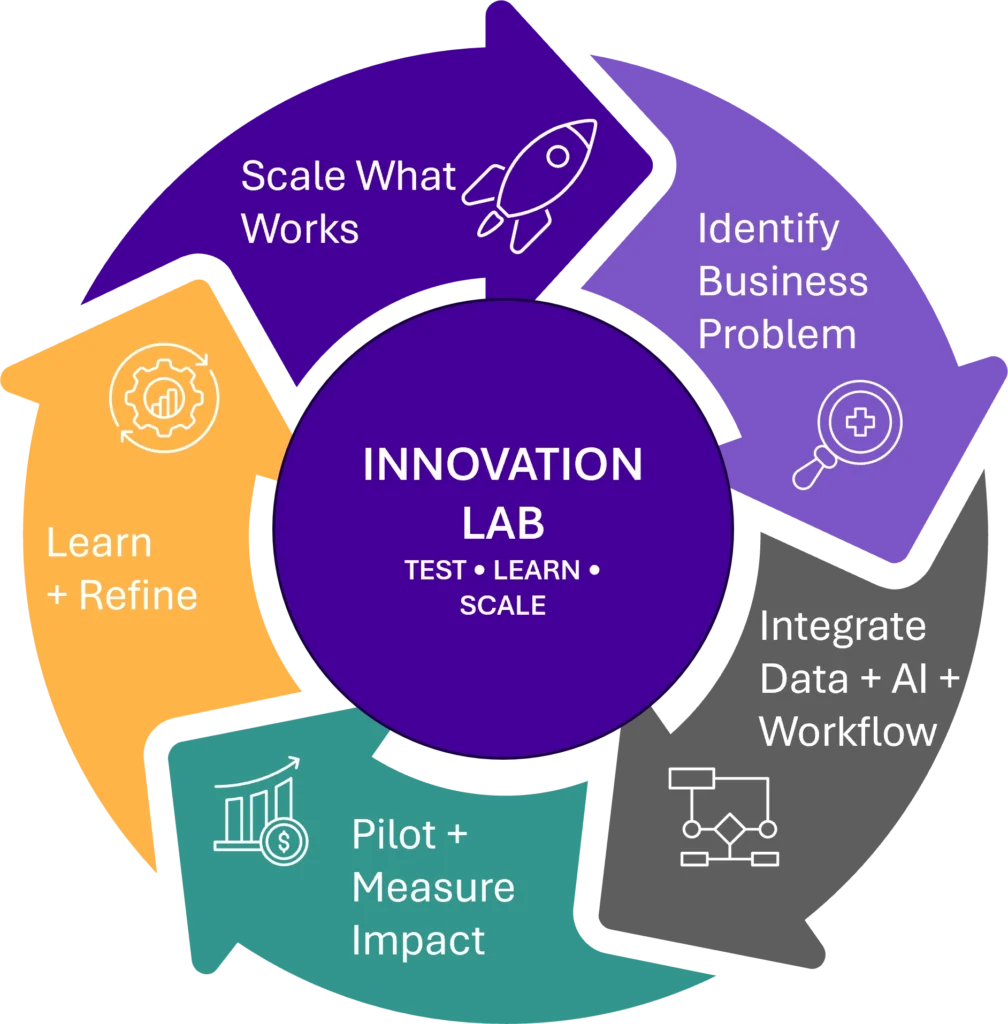
- Identify: Where can AI make a measurable difference?
- Integrate: Bring together the right data, tools, and expertise to explore the problem.
- Validate: Test the idea in a controlled, real-world setting—small scale, quick results.
- Reflect: What worked, what didn’t, and what should change?
- Operationalize: Successful POCs become roadmaps for enterprise adoption.
Approach
Sprint-Based POC Model
- Each POC was scoped to a defined business problem and executed over a four- to five-week sprint, with clear success criteria focused on feasibility, impact, and risk.
Cross-Functional Teams
- POCs brought together operational leaders, IT and analytics teams, and data platform experts, and Tegria specialists across revenue cycle, access, care operations, and data and analytics.
Embedded Governance
- Existing SLUHN committees provided oversight and prioritization, ensuring alignment with enterprise strategy, platform standards, and compliance requirements.
Spotlight: Medical Registry POC
One of the Innovation Lab POCs focused on Medical Registry automation to support clinical operations.
Key activities included:
Current State Review and Opportunity Mapping
- Mapped the end‑to‑end cancer registry journey from documentation through registry submission to pinpoint high‑value automation opportunities in identification, abstraction, and validation.
EHR Integration Design
- Designed and tested EHR data extraction and file‑based integration patterns to reduce double entry between platforms while preserving registry submission requirements.
AI-Assisted Validation and Tooling
- Piloted AI‑assisted data extraction, mapping, and validation checks, alongside a chatbot prototype to surface registry manuals and clinical guidelines at the point of abstraction.
Insights and Recommendations
- Designed human‑in‑the‑loop workflows, data stewardship checkpoints, and a phased roadmap with registry staff to extend this pattern to additional registries over time.
This approach allowed SLUHN to demonstrate that automation and AI‑assisted validation can cut abstraction time in half while improving data integrity and creating a scalable blueprint for future registry automation.
Impact and Outcomes
The AI Innovation Lab delivered value beyond individual POCs, creating a repeatable enterprise model for AI evaluation and adoption.
Risk Reduction
- Scoped data access, short POC timelines, and human-in-the-loop review minimized operational and compliance risk.
- SLUHN gained clarity on feasibility and limitations before making investment decisions.
Platform-First Insights
- Multiple POCs demonstrated that platform-native workflows, combined with analytics and AI within existing platforms can meet or exceed the value promised by external AI vendors.
Actionable Roadmaps
- Each POC concluded with clear recommendations, value estimates, and next-step options—whether to scale, refine, or stop.
Improved Data Governance Awareness
- The lab surfaced gaps in documentation standards, metadata, and data stewardship, enabling SLUHN to address foundational issues critical for safe AI adoption.
Looking Ahead
Through the AI Innovation Lab, SLUHN moved from fragmented AI experimentation and vendor noise to a governed, enterprise-ready innovation pipeline. The Medical Registry POC, alongside other lab initiatives, helped leaders understand where AI can deliver real value today, and what groundwork is required to scale tomorrow.
Ready to launch your own AI Innovation Lab?
Tegria helps healthcare organizations safely test AI, strengthen data strategies, and unlock measurable value, without unnecessary risk.
Case Study
Driving Operational Efficiency and Clean Claims Success After MaaS Go-Live
- Challenge: Implement MEDITECH as a Service (MaaS) on an aggressive timeline, including a complex scheduling data migration, patient portal onboarding, multiple clinical application builds, and post go-live revenue cycle optimization.
At a glance
Huggins Hospital
- Facility: Nonprofit community critical access hospital
- Location: Wolfeboro, New Hampshire
- EHR: MEDITECH
- Services Provided: MaaS implementation support, scheduling data migration, patient portal onboarding, clinical application build and support, clean claims optimization, revenue cycle process improvement
Key Outcomes
- On-time go-live, meeting the target date without compromise
- Outpatient productivity exceeded 100% within 75 days, surpassing stretch goals
- Achieved a 90% clean claims rate and reduced manual rework
- Strong staff engagement and portal adoption minimized disruption
Tegria was critical to the success of our MEDITECH implementation. Their team seamlessly handled the complex scheduling migration, took ownership of patient portal onboarding, and delivered expert support for our ambulatory, lab, and surgical builds. With their help, we met our aggressive go-live date and achieved strong adoption from both staff and patients.
JOE MANNCIO, Huggins Hospital
Background and Challenge
Huggins Hospital, located in Wolfeboro, New Hampshire, is a community-based critical access hospital serving the Eastern Lakes Region. As part of a systemwide digital transformation effort, the hospital moved forward with a MEDITECH as a Service (MaaS) implementation to modernize its clinical and patient access systems.
As did many community hospitals, Huggins faced significant challenges: tight timelines, limited resources, and the need to balance ongoing operations with a high-stakes system transition. Preparing for a Nov. 1, 2024, go-live, the hospital needed to complete a manual scheduling data migration, onboard patients to a new portal, and build out key applications including ambulatory, lab, and surgical services.
Solution
Huggins partnered with Tegria to supplement its internal team with experienced MEDITECH resources and implementation support. Tegria provided project management, specialized technical expertise, and the flexibility to shift resources as needs evolved throughout the project.
Tegria’s approach included:
- Deploying a tiger team to manually migrate scheduling data from legacy systems (Allscripts and CPSI) into MEDITECH within a compressed two-week window.
- Managing patient outreach and technical support for the rollout of a new consolidated portal, relieving hospital staff of onboarding responsibilities.
- Supporting the ambulatory build to keep workflows on track while Huggins staff focused on end-user support.
- Providing experienced resources for lab and surgical builds, including preference card creation, to ensure accuracy and minimize risk at go-live.
Results
With Tegria’s support, Huggins Hospital successfully launched its MaaS system on Nov. 1, 2024, meeting its target date without compromise. Ambulatory providers quickly returned to full productivity, reaching 100% of scheduled visits within 75 days and exceeding prior-year benchmarks by January.
After go-live, Huggins initially struggled to reach its goal of achieving a 90% clean claims rate. Six months post-launch, in April 2025, the hospital engaged Tegria’s revenue cycle management team to help close the gap.
With Tegria’s targeted support, Huggins reached its 90% clean claims goal by June. Since then, Tegria has continued to partner with the hospital to sustain that performance and implement workflow improvements that have significantly reduced account checks, saving staff many hours each month in reprocessing.
The whole Tegria team was able to quickly understand what we were trying to do, integrate seamlessly with our staff, and help us deliver on time. I would recommend Tegria to any organization facing a MEDITECH implementation.
JOE MANN
Tegria’s involvement drove strong adoption among both staff and patients. Freed from technical build work, hospital staff could concentrate on at-the-elbow support for end-users, fostering confidence and efficiency. On the patient side, early feedback highlighted improved access and usability of the consolidated portal, with patients noting how much easier it was to view information and pay bills online.
Ready for a seamless MaaS implementation?
Case Study
Scaling Success With ONE HITS and Expanse
- Challenge: Expanding a shared electronic health record across 23 diverse sites in northeastern Ontario required a scalable approach, strong change management, and innovative support models.
At a glance
ONE Health Information Technology Services (ONE HITS)
- Location: Northeastern Ontario, Canada
- Facility: 23 acute-care hospitals ranging from small community to large regional centers
- EHR: MEDITECH Expanse
- Services Provided: Implementation leadership, READY-certified consulting, change management, training, virtual command center support
Key Outcomes
- 23 hospitals unified on a single MEDITECH Expanse system, serving 790,000 people
- Embedded change management practices that enabled a smoother, more sustainable transition
- Successful adoption of a virtual command center model, reducing costs and improving support coverage
What I valued most about working with Tegria was their flexibility and partnership. Over three years, many of their consultants felt less like outside vendors and more like part of our team. They brought expertise, strengthened our processes, and helped us succeed in our most complex HIS project to date.
BRENDA MUTOCEO, ONE HITS
Background and Challenge
ONE Health Information Technology Services (ONE HITS) was created to deliver a shared MEDITECH Expanse system across northeastern Ontario hospitals, ensuring patients received a consistent, safe care experience across the region. After launching three founding hospitals, the team faced the challenge of scaling to 23 hospitals of varying sizes and programs. This required not just technology implementation, but also regional governance, workflow standardization, and strong change management to bring diverse stakeholders into a shared decision-making model.
Solution
To meet the scale of Wave 2, ONE HITS partnered with Tegria to provide READY-certified specialists, subject matter experts, and change management leadership. Together, they embedded policies, procedures, and roles early in the project so that new practices were in place well before go-live. This proactive approach helped ensure smoother adoption and sustainability.
Recognizing the geographic spread of hospitals, the team also introduced a regional virtual command center. This innovative model provided centralized strength while Tegria augmented local sites, giving frontline teams relief and consistent support during go-lives. By shifting to this hybrid approach, the project reduced costs, minimized staff burnout, and created a scalable framework that will be applied to future waves of implementation.
Results
Wave 2 brought 23 hospitals live on MEDITECH Expanse, standardizing workflows, strengthening governance, and ensuring patients have a consistent experience across the region. With smoother transitions and innovative support models, ONE HITS is well-positioned for its next expansion into northwestern Ontario.
Ready to leverage deep platform expertise and strong change management to scale success in your own MEDITECH Expanse implementation?
Case Study
Accelerating Revenue Cycle Performance for Measurable Financial Gains
- Challenge: Outdated systems and manual processes were impacting revenue cycle performance. Leaders wanted to tackle high denial rates and growing A/R backlogs with greater visibility into key metrics.
At a glance
Pender Community Hospital
- Facility: Critical Access Hospital
- Location: Pender, Nebraska
- EHR: MEDITECH Expanse
- Services Provided: Outsourced revenue cycle management, KPI alignment, dashboard strategy, staff training, process redesign
Key Outcomes
- Gross days in A/R dropped by more than half year over year
- Insurance denial rates declined by more than 71% compared to the previous year
- Cash collection increased from an average of $1.5 million per month to $2.8 million per month
This has been an invaluable partnership thus far, and Pender owes much of the recent success in the reduction of A/R to Tegria. I’m confident that we will look back and consider this one of the best decisions we’ve made to secure our future.
KIM HIXSONCFO, Pender Community Hospital
Background
Pender Community Hospital, located in Pender, Nebraska, has been an integral part of northeast Nebraska since 1913. An award-winning 21-bed critical access hospital, Pender offers a wide range of healthcare services, utilizing innovative technology that rivals any larger healthcare system.
Navigating the challenges of a rural healthcare environment with intricate payer structures demands a revenue cycle management system that is both agile and resilient; however, Pender’s outdated systems and reliance on manual processes hindered their revenue cycle performance. This resulted in elevated denial rates, significant A/R backlogs, and limited visibility into KPIs.
Solutions
As a critical access hospital with rural clinics, Pender faced challenges in achieving financial and operational efficiency due to complex payer rules and a lack of proper tools. Tegria took on Pender’s revenue cycle management functions, including billing, coding, revenue integrity, cash management, and leadership. As Pender’s outsourced RCM partner, Tegria assisted its teams in leveraging MEDITECH by reviewing and understanding their claims build and their clearinghouse. The analysis offered insights needed to transition billing routines back to the EHR system and to review their charging processes. By defining specific problems, measuring key metrics, analyzing root causes, and implementing solutions and controls, Pender gained a clear picture of their financial health and celebrated their improved revenue cycle performance.
Tegria’s expertise was instrumental in transforming our revenue cycle management. Their collaborative approach and deep understanding of MEDITECH’s capabilities enabled us to streamline workflows and enhance financial performance.
LAURA GAMBLECEO, Pender Community Hospital
Today, Pender continues to educate their staff to ensure EHR data is clear and actionable. By redefining productivity within their organization and adopting appropriate technology, they have positively impacted their financial performance while enhancing their commitment to quality patient care.
Results
By adopting a data-driven approach and tracking HFMA-aligned KPIs, Pender was able to establish realistic performance targets and drive improvement.
- Nearly 55% decrease in gross days in A/R
- 49% decrease in insurance-only days in A/R
- 34% decrease in A/R > 90%
- Nearly 73% decrease in A/R > 180%
- Over 71% decrease in denial rate
- Nearly doubled monthly cash collections to $2.8 million
Ready to improve your long-term financial health?
Case Study
Strengthening MEDITECH Regulatory Reporting and Compliance
- Customer: Appling Healthcare
- Challenge: After transitioning to MEDITECH Expanse, Appling Healthcare faced regulatory challenges, including gaps in coding and mapping that threatened compliance, critical reporting deadlines, and Medicare reimbursement.
At a glance
Appling Healthcare
- Facility: Nonprofit acute-care hospital
- Location: Baxley, Georgia
- EHR: MEDITECH Expanse
- Services Provided: Regulatory support, coding/mapping, reporting, third-party vendor collaboration
Key Outcomes
- Improved collaboration between quality and IT teams
- Met critical regulatory submission deadlines, securing hospital funding
- Closed coding and mapping gaps to ensure compliance
- Built a stronger, proactive regulatory foundation
- Completed Promoting Interoperability attestation under deadline
Tegria really came in and filled the gaps for us. That support was amazing, especially because getting things right from a regulatory standpoint is so important. They helped ensure everything was accurate and correct.
STEPHANIE MERCERChief Nursing Officer, Appling Healthcare
Background and Challenge
In 2024, Appling Healthcare, a rural acute-care hospital and health system in Georgia, transitioned from MEDITECH Magic to Expanse. While the new system promised long-term benefits, the shift introduced unexpected regulatory hurdles. Coding and mapping from the legacy platform did not transfer smoothly, leaving critical compliance processes incomplete. These challenges posed risks not only to regulatory compliance but also to the hospital’s financial stability, as reimbursement depended on meeting strict submission deadlines.
Solution
With limited in-house expertise in this area, Appling engaged Tegria to provide targeted regulatory support. Tegria consultants quickly assessed gaps in coding and mapping, rebuilt essential reporting functions, and collaborated directly with third-party vendors to resolve integration issues.
Working together with Appling’s quality and IT teams, Tegria created a seamless support model that combined regulatory expertise with technical problem-solving. The Tegria team helped Appling overcome immediate compliance challenges and shift from reactive problem-solving to proactive compliance planning, establishing a stronger foundation for the future.
Results
With Tegria’s support, Appling met regulatory submission deadlines, successfully completed its Promoting Interoperability attestation, and strengthened its compliance framework, ensuring continued funding and long-term sustainability.
Ready to strengthen your regulatory foundation?
Case Study
Transforming a Multi-State Health Network Through Epic Deployment
- Customer: The University of Vermont Health Network
- Challenge: Unify and modernize systems across a multi-state health system through a full Epic transformation, including clinical, departmental, and revenue cycle applications, while managing operational complexity, regulatory requirements, and large-scale change.
At a Glance
Key Outcomes
- Successfully rolled out full-suite Epic applications across six hospitals and numerous clinics
- Standardized clinical and revenue cycle workflows across a multi-state health system
- Trained and engaged more than 10,000 staff through tailored change management programs
- Developed a dedicated Epic demo environment to accelerate adoption and empower internal teams
This was truly a partnership. Tegria brought not only deep Epic knowledge but also the ability to guide us through complex change. They were seen as leaders across our teams, and their support helped us stay focused, aligned, and ready at every step.
KRISTY BROWNEpic Program Director, University of Vermont Health Network
Background and Challenge
As the University of Vermont Health Network (UVMHN) expanded into a six-hospital, multi-state system, the organization needed to standardize operations, improve care coordination, and modernize aging infrastructure. While UVMHN had long used Epic for core clinicals, the health system sought to extend Epic’s full capabilities—clinical, departmental, and revenue cycle—across diverse hospitals and clinics in Vermont and New York. Tegria was engaged to help the network achieve this goal while navigating complex regulatory environments, varied local workflows, and the challenges of large-scale change management.
Solution
From baseline review to full systemwide Epic build and deployment, Tegria supported UVMHN through every stage of its transformation. The engagement began with a detailed assessment of UVMHN’s existing Epic environment, followed by a complete redesign and phased rollout of Epic’s full suite across the health system.
Tegria provided a multidisciplinary team of more than 50 experts, including project leaders, Epic application specialists, analysts, trainers, and change management professionals. The team worked alongside UVMHN leaders to secure necessary regulatory approvals, including testimony and documentation for Certificate of Need (CON) approval from the state.
A major focus was operational standardization across facilities with distinct clinical, billing, and regulatory requirements. Tegria helped align workflows, integrate third-party systems, and streamline vendor relationships. To ensure readiness, the team delivered a comprehensive change management and training program that prepared over 10,000 staff for new systems and processes.
Tegria demonstrated flexibility and adaptability during the engagement by seamlessly pivoting from fully onsite to fully remote support when in-person work was restricted. The team worked closely with UVMHN to establish a scaled-down on-site presence for key milestones and developed effective approaches for remotely supported go-lives. This shift not only maintained project momentum in a dynamic environment, but also reduced travel costs and helped establish remote go-live support as a standard practice for the organization.
This flexible, responsive approach was tested later the same year, when a ransomware attack threatened to cripple the UVMHN infrastructure and halt the project in its tracks. True to form, Tegria provided rapid response and recovery support to restore systems and keep the rollout on track.
To accelerate adoption and reduce technical burden on internal teams, Tegria designed and implemented a dedicated Epic demo environment. This environment supported role-based training, workflow simulations, and validation exercises in a safe, realistic setting.
Throughout the multi-year engagement, Tegria served as a strategic partner and consistent source of leadership, knowledge, and stability.
Results
UVMHN achieved a successful full-suite Epic rollout across its health system, standardizing operations and enabling network-wide alignment. Staff adoption was high, training was effective, and the organization is now positioned for long-term efficiency and growth with a modern, scalable EHR foundation.
From baseline review to full Epic deployment, Tegria delivers the expert guidance and operational support healthcare systems need to evolve.
Let’s talk about how we can help unify and strengthen your organization.
Case Study
Fixing a Costly Billing File Error To Deliver Major Monthly Savings
- Challenge: Persistent billing file errors led to over $150,000 in monthly lost revenue and excessive manual cleanup work.
At a Glance
- Organization: Nonprofit health insurance provider
- Location: Midwestern U.S.
- Services Provided: Error analysis, root cause identification, backend fix, workflow improvements, validation testing
Key Outcomes
- Resolved a recurring billing file error affecting Enhanced Population Health payments
- Reduced monthly billing losses by $130,000
- Recovered an estimated $780,000 in missed revenue
- Eliminated the need for time-consuming manual error cleanup
This one fix had a huge impact—it improved efficiency and financial performance. Instead of a workaround, we uncovered the root cause and worked across the organization to improve our workflows. The results speak for themselves. This partnership has been a win.
CLIENT PROJECT LEAD
Background
A large Midwestern payer was grappling with a persistent billing challenge. For months, the organization had been experiencing high volumes of invalid billing rejections—particularly on its billing detail file, resulting in delayed or lost reimbursements. These rejections were tied to value-based payments’ not being accurately reflected, causing significant monthly revenue losses.
A short-term workaround was in place; but it demanded ongoing manual cleanup, adding operational inefficiencies to the financial strain.
Solution
Tegria partnered with the payer to first analyze the billing detail file and associated error logs. This analysis then led us to determine the need to investigate the main source of the errors. Through deep data analysis and collaboration with Finance and IT stakeholders, the team identified and addressed the root cause in the billing file generation process.
Approach:
- Analyzed historical billing detail file trends to quantify financial impact
- Identified the root cause for the data discrepancy
- Implemented a backend fix to correct the billing file logic and eliminate manual workaround
- Validated improvements through comparison of post-fix billing files
Results
The impact of the backend fix was immediate and significant. Monthly billing losses due to errors dropped from over $150,000 to just over $20,000—a reduction of nearly 87%. This improvement has allowed the payer to recover an estimated $780,000 in historical lost revenue.
Additionally, the fix has eliminated the need for manual cleanup of rejected bills, freeing up staff time for higher-value tasks and boosting overall operational efficiency.
Maximize your technology investments by optimizing performance.
Case Study
Boosting Clinical Efficiency and Capacity With Tier 3 Epic Support
- Challenge: Montage Health needed a scalable, cost-effective solution to support Epic system upgrades, reduce alert fatigue, and maintain progress on capital projects without overburdening internal staff.
At a glance
Montage Health
- Facility: Nonprofit healthcare network
- Location: Monterey County, California
- EHR: Epic
- Services Provided: Epic Tier 3 support, upgrade management, capital project support, workflow optimization, population health outreach
Key Outcomes
- Reduced Epic OPA volume by up to 58%, easing clinician burden
- Enabled strategic focus on 13 Epic upgrades and Gold Stars achievement
- Resolved systemic faxing issues, saving 28 hours per month in staff time
- Supported population health outreach to more than 117,000 patients
Tegria’s support allows us to stay focused on strategic initiatives such as upgrades and capital projects, without diverting resources away from operational work. It makes a significant difference in our overall capacity.
SHELLI PAGE, MSN, RN, NI-BCDirector of Epic Applications, Montage Health
Background
Montage Health is a nonprofit health system serving communities throughout Monterey County, California. As a local organization with a broad network of services—including a hospital, medical group, urgent care centers, and a Medicare Advantage plan—Montage Health is committed to delivering coordinated, high-quality care.
To keep up with strategic initiatives while maintaining day-to-day operations, Montage Health needed a reliable partner to supplement its internal Epic applications team. Initially seeking Tier 2 support to stabilize operations and reduce backlog, Montage Health later recognized the need for deeper, more strategic support to manage upgrades, capital projects, and high-impact system enhancements without expanding internal headcount.
Solutions
After partnering with Montage Health in 2020, Tegria evolved its role from Tier 2 to Tier 3 strategic support. In this role, Tegria provided upgrade management, assisted with over 50 capital projects, and supported more than 25 Epic applications. The team supported 13 system upgrades, including Hyperdrive, and led integrated testing efforts to reduce risk and ensure smooth rollouts.
Together, Montage Health and Tegria developed a flexible and sustainable support model, aligning Tegria’s hours with capital project timelines. This approach ensured that upgrades and large-scale initiatives received focused attention, while allowing Montage Health’s internal teams to maintain momentum on operational goals.
Deeply embedded within the organization, Tegria’s team addressed long-standing technical and workflow challenges to improve efficiency and operations. Their efforts helped cut Our Practice Alert (OPA) volumes nearly in half, saved 28 hours of staff time per month, and supported population health efforts that reached more than 117,000 patients with targeted outreach and documentation improvements.
Tegria’s support also enabled Montage Health to achieve Epic’s Gold Stars 9 recognition for the fifth time, Page said: “Their involvement made it possible for us to remain on schedule with complex projects while continuing to meet Epic’s evolving Gold Star criteria.”
Results
- Reduced Epic OPA fatigue: 46%–58% reduction in alert volume for clinical users
- Resolved systemic faxing issues, reducing from 20 per day to four per day and saving 28 staff hours monthly
- Enabled outreach to 45,000 patients with hypertension and 72,000 patients with diabetes via new Epic-based workflows
- Rerouted critical Pathologist Review results, improving follow-up on 15+ potential malignancies per month
Ready for a flexible Epic support partner that feels like part of your team?
Case Study
Targeted Intervention Reduces Denials for Large Southeast Health System
- Challenge: Reduce denial rate and improve workflows
At a Glance
- Facility: Integrated healthcare system
- Location: Southeast
- EHR: Epic
- Services Provided: Targeted denials analytics, Epic system optimization, root cause analysis, workflow redesign
Key Outcomes
- 25% reduction in primary denial rate
- 2.5% reduction in overall hospital billing (HB) denial rate
- 275,000 fewer denials annually
- $50,000 – $100,000 A/R reduction per month
Tegria was a great partner for our Denials Improvement Project. They were able to come in and help us put together plans around a lot of our top denials, then build and test those updates in the system so our IT teams could focus on other pressing needs. In a year, we were able to drop our primary denial rate by over 25%.
EXECUTIVE DIRECTOR OF REVENUE CYCLE
Background and Challenge
One of the country’s largest healthcare providers recognized the need to reduce its denial rate. While the primary goal was denial reduction, there were additional concerns with the volume of denials falling into work queues that required no end-user intervention, inflating queue volume. In summary, the organization was experiencing:
- High primary denial rates.
- Elevated overall HB denial rates.
- Inflated work queue volumes for items requiring no end-user intervention.
Solution
Tegria leveraged its denials expertise to assess and address these denial challenges. The approach included:
1. Targeted Analysis: Investigating specific denial categories to uncover root causes.
2. Collaborative Approach: Working closely with operational and IT teams.
3. System Optimization: Implementing Epic system enhancements to prevent denials and automate follow-ups.
Results
This large health system successfully reduced its denial rate through targeted interventions and expert guidance, surpassing industry benchmarks. This accomplishment has led to significant improvements in both administrative workloads and cash flow. The significant result serves as a model for healthcare organizations that seek to optimize their financial operations and enhance patient care by improving revenue cycle processes.