Insight
Realizing AI’s Promise: How Data Governance Supports AI Success
Exploring why governance matters and how to build a strong framework for responsible AI adoption
Artificial intelligence is widely seen as a breakthrough technology for healthcare. From improving diagnostics and personalizing care to reducing administrative burden, the potential benefits are enormous. But as organizations move quickly to adopt AI, many are realizing that their data foundation isn’t ready.
AI governance isn’t separate from data governance—it’s built on it. Without consistent data definitions, stewardship, and quality checks, AI becomes guesswork, not innovation.
MARK LEIFERManager, Analytics Support
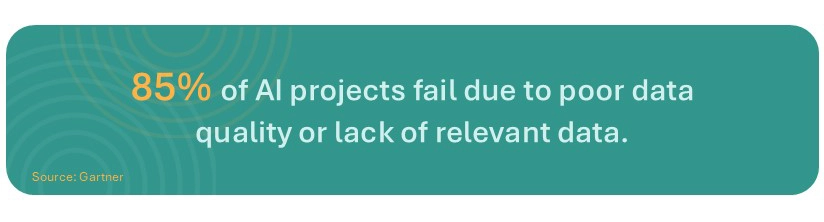
That’s because for many, advancements in AI have outpaced existing data governance frameworks. For AI tools to deliver safe, useful results, they need accurate, well-managed, and trustworthy data. Without this foundation, even the most advanced models will fall short. Gartner reports that 85% of AI projects fail due to poor data quality or lack of relevant data. In healthcare, where patient trust and data privacy are paramount, the risks are even higher.
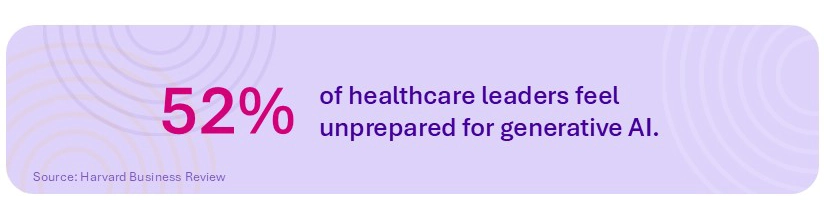
Among healthcare leaders, readiness is a growing concern. Per a Harvard Business Review report, 52% say they feel unprepared for generative AI, and 39% cite data issues as their biggest obstacle to scaling these technologies. As the pressure to adopt AI increases, organizations that treat governance as a strategic capability will be in a much better position to deliver meaningful results.
Why Data Governance Is a Must-Have
AI is moving fast, and healthcare leaders are feeling the pressure to act. Vendors are promoting a wide range of AI tools, peer organizations are launching new initiatives, and executive teams want to see progress. At the same time, compliance expectations are evolving. Regulations like HIPAA, the EU AI Act, updated FTC guidelines, and proposed updates to HIPAA are raising the bar for transparency and accountability.
One of the biggest barriers to implementing AI and advanced analytics is the lack of foundational data governance. Without it, you're trying to build predictive models on top of unreliable data.
PHIL HEFFLEYManaging Director, Analytics & Insights
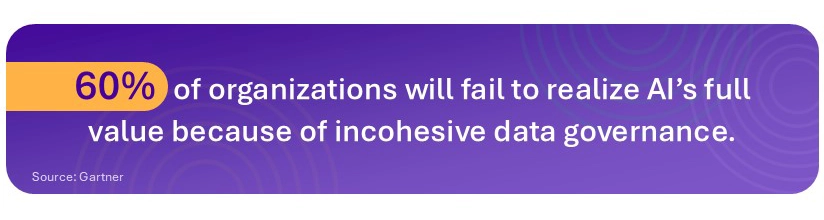
Organizations that embed governance from the outset are better positioned to accelerate AI deployment, scale innovations, and meet compliance demands—all without rework. Gartner predicts that, by 2027, “60% of organizations will fail to realize AI’s full value because of incohesive data governance.” Data governance creates the structure needed to use AI safely and effectively while ensuring that data practices meet current and future regulatory standards. Strong data governance also helps organizations accelerate the value of AI by improving data quality, consistency, and access across teams.
What’s Standing in the Way
Many healthcare organizations are eager to implement AI but haven’t addressed the underlying governance gaps that could derail those efforts. Several common challenges contribute to this disconnect:
- AI projects often operate independently from broader data governance frameworks.
- Roles and responsibilities for data ownership and quality are unclear.
- Governance is still viewed as the responsibility of IT, rather than a shared enterprise function.
These issues can lead to misaligned priorities, inconsistent results, and low trust in AI outputs.
Signs of Poor Data Governance
Not all governance problems are immediately obvious. However, there are several clear markers of inadequate data governance. These signs indicate that an organization may not be ready to adopt AI at scale:
- A persistent backlog of data and reporting requests
- No clear answer to the question “Who owns data governance?”
- Failed or stalled analytics or AI projects
- A lack of performance metrics or feedback loops for data and AI tools
- Data-related decisions driven by organizational hierarchy rather than strategic need
These are symptoms of deeper issues around alignment, ownership, and accountability that need to be addressed before AI can succeed.
What Can Go Wrong Without Governance
Weak or absent governance introduces several risks that can impact care quality, compliance, and trust:
- Unreliable outputs. Poor data quality leads to flawed AI recommendations and insights.
- Compliance violations. AI tools that are opaque or unexplainable can expose the organization to regulatory risk.
- Loss of trust. A single AI-related mistake can reduce confidence among clinicians, patients, and partners.
- Ethical missteps. Without oversight, AI systems may reinforce bias or misuse sensitive data.
- Wasted investment. AI tools that are not built on a solid governance foundation often fail to scale or deliver return on investment.
The consequences are especially serious in healthcare, where data integrity, transparency, and patient safety are non-negotiable.
What Healthcare Leaders Can Do
To realize the benefits of AI, healthcare organizations need to approach it as a data-centric initiative. Governance should be tightly integrated with any AI strategy, not treated as an afterthought or separate track.
The following steps can help healthcare leaders build the foundation needed for safe, scalable AI.
1. Start With a Governance Maturity Assessment
Before committing to AI projects, assess the current state of your data governance. A maturity assessment helps identify gaps in data quality, ownership, and alignment.
Start with a well-scoped use case and apply strong governance around it to build experience and trust.
- Focus on areas where AI is already being used or explored
- Evaluate accessibility, reliability, and documentation standards
- Assess the readiness of structured and unstructured—from sources like notes, transcripts, and imaging—data
- Identify gaps in stewardship and accountability
- Use assessment results to inform a phased improvement plan
2. Secure Executive Sponsorship and Build a Governance Coalition
Data governance requires leadership support and cross-functional engagement. Assigning an executive sponsor ensures authority, alignment with strategic goals, and access to critical resources.
Form a governance council representing IT, clinical, compliance, and operational domains to develop policies, oversee execution, and report progress to senior leadership. The sponsor should champion governance across the enterprise, remove barriers, and help reinforce its strategic importance.
- Designate a sponsor such as the CIO, CDO, or CMIO
- Allocate funding for technology, training, and stewardship
- Align governance with business outcomes to reinforce its strategic value
- Encourage collaboration across departments and disciplines
- Ensure the sponsor regularly communicates governance value to executive peers
Governance must be addressed early as an organizational decision and long-term commitment. Once the framework is in place, data consumers begin to see improved reliability, stronger outcomes, and real momentum.
PHIL HEFFLEYManaging Director, Analytics & Insights
3. Develop Practical Policies and Embed Them in Workflows
Effective governance policies must be clear, actionable, and part of day-to-day work. Define how data will be accessed, shared, and used for AI, and make sure policies are tied to operational checkpoints.
For example, require governance approval before deploying AI tools, and integrate data quality checks into EHR systems and reporting workflows.
- Create policies covering data access, AI usage, retention, and review
- Require governance checkpoints before AI tools are deployed
- Include data quality reviews in reporting and EHR workflows
- Define clear responsibilities for approvals and audits
4. Empower Data Stewards and Strengthen Data Literacy
Governance depends on the people closest to the data. Data stewards—whether analysts, managers, or directors—have the expertise to detect inconsistencies, validate quality, and identify risk.
Stewardship isn’t about adding new roles—it’s about recognizing and formalizing existing accountability. Data stewards already exist across your organization; governance simply gives them a name, a framework, and support.
Good governance involves cross-functional teams and clear data ownership roles (not just the IT department).
At the same time, investing in data literacy across teams helps ensure that everyone understands how their work contributes to trustworthy AI.
- Identify stewards within clinical, operational, and technical domains
- Provide training on governance tools and responsibilities
- Help clinicians understand the downstream impact of documentation
- Foster a culture that views data quality as a shared responsibility
5. Implement Supporting Technology Strategically
The right tools can help enforce governance standards and scale them across the organization. However, technology decisions should follow governance strategy—not drive it.
Look for solutions that support your policies and make it easier to monitor, document, and improve data and AI performance.
- Ensure a trusted source of truth with tools that provide visibility into where data comes from and how it’s used
- Implement platforms for monitoring data quality and AI model behavior
- Ensure technology aligns with the organization’s governance policies, not the other way around
6. Measure Progress, Adapt, and Sustain the Program
Governance is a long-term capability that must evolve over time. Track impact through measurable indicators, adjust as needed, and share progress to maintain engagement and support.
Highlight success stories that show how governance contributed to safer or more effective AI use. These examples build confidence and help reinforce the importance of ongoing investment.
- Define metrics like data quality scores, AI approval rates, and resolution times
- Review policies regularly in response to changes in regulations or technology
- Highlight success stories to build momentum and trust
- Treat governance as a continuous improvement process
The Bottom Line
Strong data governance is essential for any healthcare organization planning to use AI responsibly. Without it, AI projects are more likely to produce unreliable results, create compliance risks, and fail to deliver long-term value.
Yes, establishing data governance takes time, but taking the time to focus on governance is a solid investment—one that may accelerate results over time. A solid data governance foundation helps healthcare leaders gain insights faster, improve patient outcomes, and increase trust across teams. Projects move forward more smoothly and are less likely to stall, flounder, and fail.
Now is the time to act. Whether through a governance maturity assessment, a cross-functional task force, or targeted training, taking the first step today sets the stage for future success with AI.