Case Study
Accelerating Value, Reducing Risk: SLUHN AI Innovation Lab
- Challenge: Facing growing operational and financial pressure and an influx of AI vendors, SLUHN needed a governed approach to validate AI value before committing to large-scale investments.
At a glance
St. Luke’s University Health Network
- Facility: Nonprofit health network
- Location: Bethlehem, Pennsylvania
- Services Provided: AI Innovation Lab design and facilitation, proof-of-concept (POC) execution, AI and advanced analytics evaluation, digital workforce assessment and prototyping, data integration and governance guidance, and enterprise AI roadmap development
Key Outcomes
- Launched a governed AI Innovation Lab to safely evaluate and prioritize AI use cases
- Validated platform-driven alternatives to AI vendors
- Demonstrated the feasibility of a Digital Workforce for financial operations
- Delivered clear go / no-go decisions and scalable AI roadmaps
Through the Innovation Lab, we explored early-stage AI concepts related to documentation, abstraction, and operational workflows in a controlled, governance-focused environment. While the work was exploratory in nature, it provided valuable insight into potential opportunities and considerations as we continue to thoughtfully evaluate this emerging technology.
CHERYL DAVIDSON,MSN, RN, Sr. Network Director, Data Abstraction & Registry Services
Background and Challenge
Like many large health systems, St. Luke’s University Health Network (SLUHN) faced growing operational and financial pressures alongside a surge of AI vendors promising automation across revenue cycle, patient access, registries, and contract management. While leadership recognized the potential of AI and advanced analytics, they also faced significant risks:
- High uncertainty and risk in committing to multi-year AI platform investments without clear evidence of value, data readiness, or workflow fit
- Vendor overload, with limited internal capacity to objectively compare “build vs. buy” options or evaluate platform-native capabilities versus niche AI products
- Governance and trust concerns, including the need for strong data stewardship, compliance, and human oversight in AI-enabled workflows
SLUHN needed a structured way to move from AI curiosity to action—without disrupting care, compromising governance, or over-investing in unproven solutions.
Solution: The AI Innovation Lab
In partnership with Tegria, SLUHN launched an AI Innovation Lab—a sprint-based, governed framework designed to safely test and validate AI use cases before scaling.
The Innovation Lab provided SLUHN with a low-risk environment to:
- Validate AI opportunities through focused proofs-of-concept (POCs)
- Demonstrate measurable clinical, operational, or financial value
- Maintain platform principles and data governance standards
- Create clear go/no-go decisions and scalable roadmaps
Each Innovation Lab cycle moved from intake to insight through executive governance, structured prioritization, and close collaboration between SLUHN leaders, subject matter experts, and Tegria consultants.
Innovation Lab Cycle
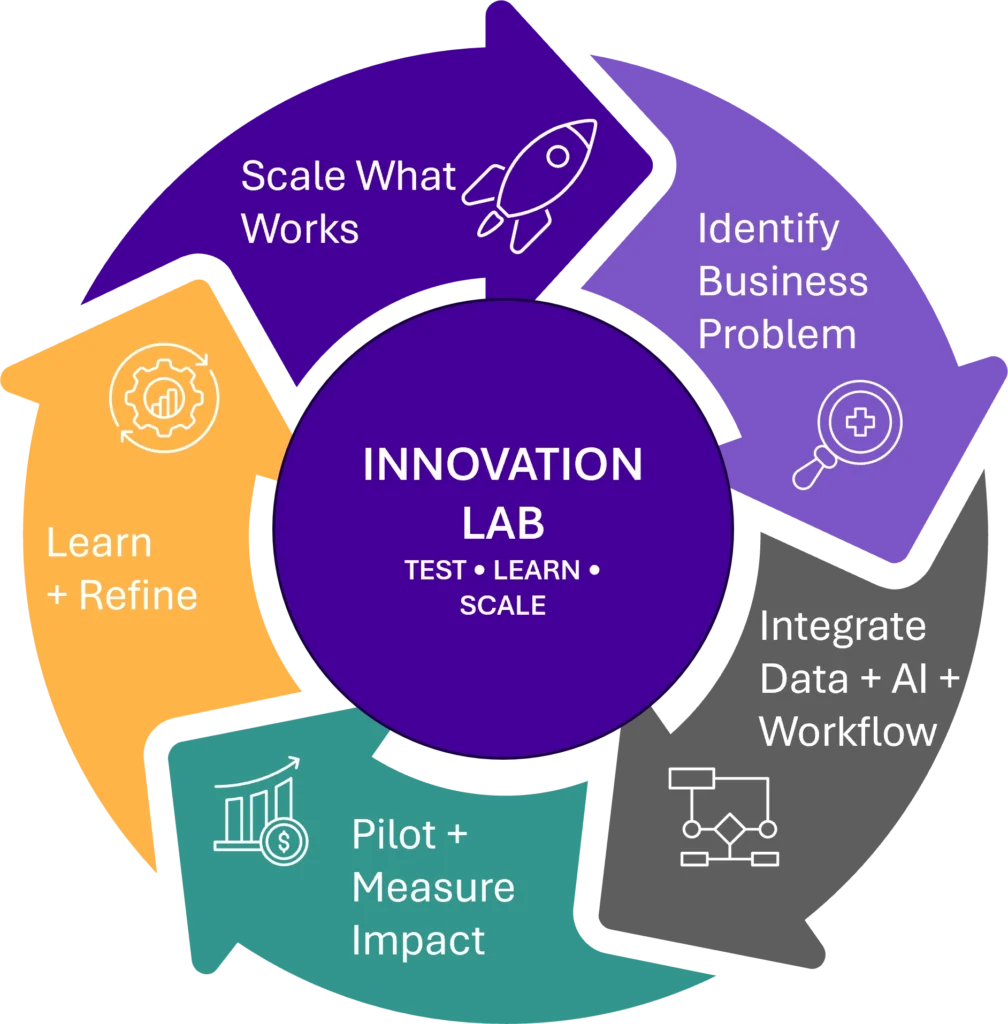
- Identify: Where can AI make a measurable difference?
- Integrate: Bring together the right data, tools, and expertise to explore the problem.
- Validate: Test the idea in a controlled, real-world setting—small scale, quick results.
- Reflect: What worked, what didn’t, and what should change?
- Operationalize: Successful POCs become roadmaps for enterprise adoption.
Approach
Sprint-Based POC Model
- Each POC was scoped to a defined business problem and executed over a four- to five-week sprint, with clear success criteria focused on feasibility, impact, and risk.
Cross-Functional Teams
- POCs brought together operational leaders, IT and analytics teams, and data platform experts, and Tegria specialists across revenue cycle, access, care operations, and data and analytics.
Embedded Governance
- Existing SLUHN committees provided oversight and prioritization, ensuring alignment with enterprise strategy, platform standards, and compliance requirements.
Spotlight: Medical Registry POC
One of the Innovation Lab POCs focused on Medical Registry automation to support clinical operations.
Key activities included:
Current State Review and Opportunity Mapping
- Mapped the end‑to‑end cancer registry journey from documentation through registry submission to pinpoint high‑value automation opportunities in identification, abstraction, and validation.
EHR Integration Design
- Designed and tested EHR data extraction and file‑based integration patterns to reduce double entry between platforms while preserving registry submission requirements.
AI-Assisted Validation and Tooling
- Piloted AI‑assisted data extraction, mapping, and validation checks, alongside a chatbot prototype to surface registry manuals and clinical guidelines at the point of abstraction.
Insights and Recommendations
- Designed human‑in‑the‑loop workflows, data stewardship checkpoints, and a phased roadmap with registry staff to extend this pattern to additional registries over time.
This approach allowed SLUHN to demonstrate that automation and AI‑assisted validation can cut abstraction time in half while improving data integrity and creating a scalable blueprint for future registry automation.
Impact and Outcomes
The AI Innovation Lab delivered value beyond individual POCs, creating a repeatable enterprise model for AI evaluation and adoption.
Risk Reduction
- Scoped data access, short POC timelines, and human-in-the-loop review minimized operational and compliance risk.
- SLUHN gained clarity on feasibility and limitations before making investment decisions.
Platform-First Insights
- Multiple POCs demonstrated that platform-native workflows, combined with analytics and AI within existing platforms can meet or exceed the value promised by external AI vendors.
Actionable Roadmaps
- Each POC concluded with clear recommendations, value estimates, and next-step options—whether to scale, refine, or stop.
Improved Data Governance Awareness
- The lab surfaced gaps in documentation standards, metadata, and data stewardship, enabling SLUHN to address foundational issues critical for safe AI adoption.
Looking Ahead
Through the AI Innovation Lab, SLUHN moved from fragmented AI experimentation and vendor noise to a governed, enterprise-ready innovation pipeline. The Medical Registry POC, alongside other lab initiatives, helped leaders understand where AI can deliver real value today, and what groundwork is required to scale tomorrow.
Ready to launch your own AI Innovation Lab?
Tegria helps healthcare organizations safely test AI, strengthen data strategies, and unlock measurable value, without unnecessary risk.